
 Blogs
Blogs 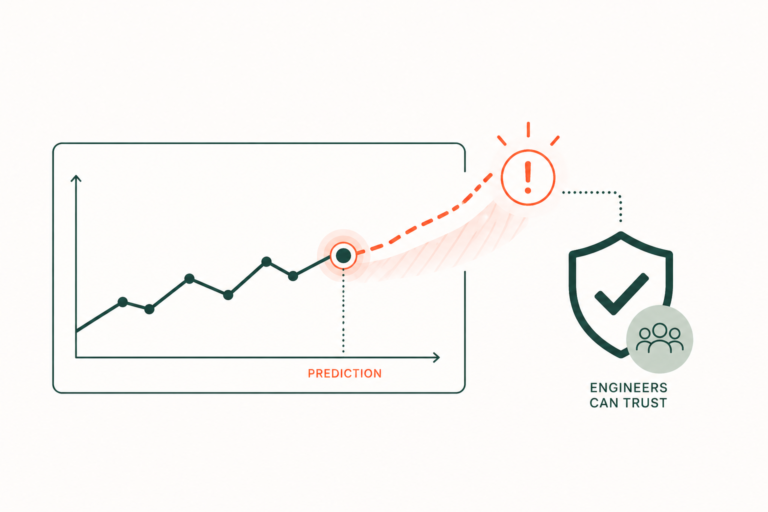
Incident prediction is one of the most attractive promises in AIOps, and one of the easiest to get wrong. Every reliability leader wants earlier warning before customers feel the impact. Nobody wants another noisy signal that burns on-call trust and gets muted after a few bad weeks.
That’s why prediction has to be proven before it pages anyone. In our webinar, “Replacing Rule-Based AIOps with Predictive Reliability Workflows,” we make the case that prediction can’t stand alone as a probability score. It has to become part of a workflow where weak signals turn into evidence, evidence becomes causal context, and context leads to safer action.
Why Incident Prediction Fails in Production
Prediction usually doesn’t fail because the math is bad. It fails because the output lands in an unforgiving operational environment. On-call teams don’t have patience for vague warnings, and they shouldn’t. Every false positive spends credibility, and credibility is hard to win back.
Google’s Incident Management Guide frames automation as useful when it reduces cognitive load through impact analysis, root cause analysis, and intelligent mitigation suggestions. That’s the right standard for prediction too. A warning that says “85% chance of incident” without explaining what changed, where it changed, or what to do next just creates another investigation.
That’s why many “smart alerting” projects quietly turn into alert prediction. The model learns the quirks of thresholds, routing rules, suppression, and deduplication, then predicts late-stage symptoms instead of the early signals that started the failure chain. It may be technically accurate and still operationally weak.
Define Success Like an Operator
Prediction programs go sideways when teams measure success only as model accuracy. Operations teams need a different definition. They care whether the signal arrives early enough, points to the right area, reduces coordination time, and changes what responders do.
Lead time matters, but only when it’s useful. A few minutes can help if they route the right owner or narrow the first investigation. Longer lead time matters more when it creates room for a rollback, capacity adjustment, or feature flag change before customer impact spreads.
Actionability is the real constraint. Google Cloud’s guidance on relevance and outcomes for alerting is useful here because it argues that signals should be tied to intended outcomes. Prediction should meet the same bar. If it doesn’t change a decision, it shouldn’t wake a human.
Prove Prediction Before It Touches Paging
The safest validation pattern starts with history. Build a representative set of past incidents, including deploy regressions, dependency slowdowns, queue backlogs, resource saturation, and high-impact customer-facing issues. Then replay telemetry in time order as if the incident were happening live.
This avoids the most common trap: hindsight bias. The system should only use information that would’ve been available at that moment. If the prediction fires after customers already complained, it didn’t predict the incident. If it fires early but can’t explain why, it’s not ready for the frontlines of on-call.
After historical replay, move into shadow mode. Let predictions run live, but don’t page anyone. Route them to a safe review channel or dashboard where a small group can inspect timing, specificity, evidence quality, and usefulness. The goal isn’t to prove perfection. It’s to learn whether prediction helps without changing the on-call experience.
Prediction Has to Show Its Work
Engineers don’t trust labels. They trust evidence they can validate quickly. A credible prediction should read like a short operational briefing, not a black-box forecast.
It should show the top precursor anomalies, where they occurred, and how they connect across services, dependencies, or regions. It should explain the likely propagation path and state an impact hypothesis in plain operational language, such as higher timeout risk on a payments path or rising latency on checkout. It should also recommend where to investigate first or which runbook-backed mitigation to consider.
That evidence bundle is what separates predictive reliability from another alert stream. Without it, responders have to do the validation work themselves, which means the prediction has already failed part of its job.
Alert-Only Prediction Starts Too Late
If the prediction pipeline depends mostly on alert events, it inherits the blind spots of the alerting system. Alerts are downstream artifacts. They’ve already passed through thresholds, suppression rules, routing policies, and assumptions about what failure should look like.
Early failure signals often live elsewhere. They appear as slow latency drift, rising queue depth, retry amplification, trace span changes, log pattern shifts, or dependency behavior that hasn’t crossed a paging threshold yet. That’s why prediction needs high-fidelity telemetry, not just the alert stream.
OpenTelemetry’s specification principles emphasize universal, vendor-neutral telemetry. The operational takeaway is straightforward: predictive AIOps works better when it reasons from system evidence before that evidence is compressed into alerts.
Earn the Right to Page
Paging should be the final stage of adoption, not the first. After shadow mode, the next step is human-in-the-loop triage. Route predictions to a small group, such as the primary on-call plus an incident lead, and let them decide whether the signal is useful enough to escalate.
Controlled paging should start narrow. Pick a few services, a few high-confidence patterns, or a class of incidents where lead time clearly matters. Require evidence every time. No evidence, no page.
This rollout matches the discipline recommended in Google Cloud’s Operational Excellence guidance for managing incidents and problems, which emphasizes clear procedures, centralized incident management, knowledge reuse, and automation. Prediction should be introduced with the same care as any other high-stakes reliability change.
Deliver Prediction Where Work Happens
Even a strong prediction can fail if it lives in the wrong place. During incidents, teams work in paging systems, incident channels, ITSM tickets, and runbooks. If prediction sits in a separate console, responders may not see it until after they’ve already built their own theory.
Modern AIOps has to meet the workflow. If a team runs incidents through ServiceNow, Jira, Slack, PagerDuty, or an internal incident portal, prediction should enrich those systems with evidence, likely impact, ownership hints, and next steps. The value isn’t another dashboard. It’s a better first action.
Incident prediction succeeds when it’s treated as a production capability, not a feature toggle. It needs telemetry inputs, historical replay, shadow mode, evidence bundles, phased rollout, false-positive measurement, and workflow-native delivery.
That’s the shift behind predictive reliability. The goal isn’t to predict every possible incident. It’s to reduce business impact by proving which signals are credible before they ever wake on-call.
Make Incident Prediction Credible
To see the full approach, watch our webinar. To try a modern take on AIOps in your own environment, sign up for InsightFinder and see how weak signals become evidence-backed predictions and workflow-native actions.


