
 Blogs
Blogs 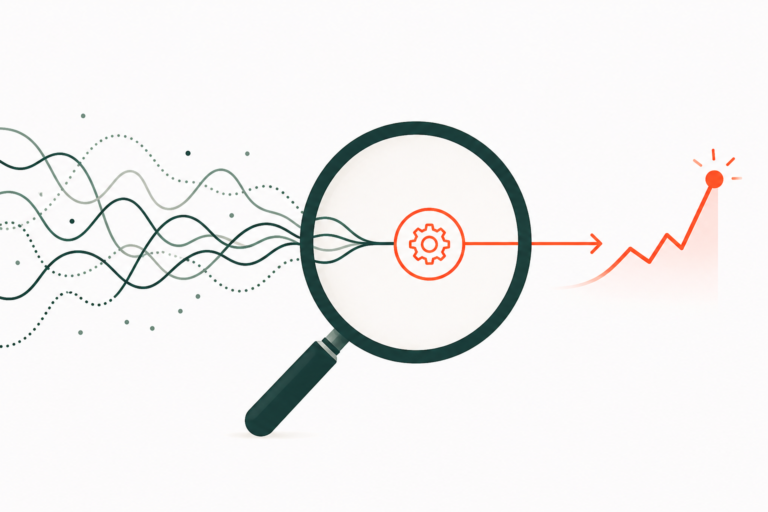
Correlation makes incidents look more orderly. Five alerts fire together, the ticket gets a clean summary, and the dashboard tells a tidy story about what happened. For a team drowning in alerts, that can feel like progress.
What’s problematic is when that tidy story is accepted as a root cause. In real incidents, the loudest component is often just the place where failure became visible. The real origin usually happened earlier, upstream, and quietly enough that a correlation engine may miss it entirely.
That distinction is explored in our webinar, “Replacing Rule-Based AIOps with Predictive Reliability Workflows.” The core argument is practical: correlation can reduce noise, but causality is what helps teams reduce uncertainty, shorten triage, and act with confidence during production incidents.
Why Correlation-Heavy AIOps Falls Short
Correlation tools aren’t useless. They can deduplicate alert storms, group related symptoms, and reduce paging volume. Most enterprise teams need those capabilities, especially when fragmented observability tools create too many disconnected signals.
But correlation starts to fail when responders need to know what changed first. A cluster of co-occurring alerts doesn’t explain which signal is causal, which one is downstream, or which action is safest. It organizes the scene, but it doesn’t necessarily tell the team where to start.
That’s why correlation-heavy “RCA” often becomes a guessing game with better formatting. The system compresses the alert storm into something readable, then hands engineers the hardest part of the job: deciding what actually caused the incident.
Google’s SRE incident management guidance makes a related point in operational terms. It emphasizes structured response, fast mitigation, and automation that can help with impact analysis, root cause analysis, and intelligent suggestions for mitigating actions. A pile of correlated alerts doesn’t meet that bar.
Incidents Don’t Start at the Pager
Distributed systems rarely fail all at once. They fail through chains of small changes that compound over time. The pager usually fires near the end of that chain, not at the beginning.
A common pattern starts with a deployment that changes retry behavior. The service still appears healthy, so nothing major fires. Retries slowly increase load on a downstream dependency. A queue begins to back up, latency drifts upward, and upstream services hold resources longer. Only later do broad timeouts and error spikes trigger the obvious alerts.
A correlation engine will naturally focus on what’s loud at the end. That might include gateway timeouts, saturation alerts, and elevated latency. Those signals matter, but they may describe the visible failure rather than the origin.
Causal analysis asks a different question. It looks back before the incident trigger and asks what changed the system’s trajectory. That’s the question on-call engineers need answered when every minute of uncertainty adds pressure.
A Payments Incident Shows the Difference
Imagine a Payments service that starts timing out at 2:10 PM. Most AIOps tools group alerts from the API gateway, the payments service, thread pool saturation, and downstream call failures. The gateway looks central because it’s where the loudest alerts appear.
But the real story started at 1:35 PM. A deployment changed a retry policy, which increased call volume to a fraud-scoring service. Fraud scoring slowed down but didn’t fail outright. A queue grew gradually, then payments latency increased, then the gateway started failing fast.
Correlation tells the team what spiked together. Causality helps the team see the chain: retry change, dependency pressure, queue growth, latency drift, timeout spike. That difference matters because the first useful hypothesis often determines whether responders mitigate quickly or burn another hour chasing symptoms.
This is why root cause labels aren’t enough. Engineers need evidence they can inspect quickly. They need to see the metric anomaly, the trace path, the log pattern, and the dependency relationship that supports the recommendation.
Causal RCA Needs More Than Alerts
Many AIOps platforms plateau because they rely too heavily on alert streams. Alerts are downstream artifacts. They’ve already been filtered through thresholds, suppression rules, routing policies, and assumptions about what failure should look like.
That creates a hard limit. If a weak signal never became an alert, an alert-only system can’t use it. If the earliest clue lived in a trace, a log pattern, a topology change, or a slow metric drift, correlation over alert events won’t reconstruct the full chain.
Modern RCA needs richer evidence across telemetry layers. Metrics reveal saturation, drift, backlog growth, and throughput changes. Traces show where latency accumulates across request paths. Logs explain state transitions, exceptions, degraded modes, and timeout behavior. Dependency context shows which services can plausibly affect one another.
That’s also why OpenTelemetry matters in the broader observability ecosystem. It provides a vendor-neutral framework for capturing telemetry such as traces and metrics, which helps teams preserve useful system evidence across complex environments.
Causality Matters More as Systems Get More Complex
Causality isn’t just a marketing argument. It reflects a real technical problem in high-dimensional systems. When dozens or hundreds of signals move together, “what correlated” becomes a weak basis for root cause identification.
Research on multivariate time-series anomaly detection points in the same direction. This paper frames anomalies as violations of regular causal mechanisms and argues for causal structure as a way to identify root causes in complex time-series data.
Enterprise teams don’t need to implement academic causal discovery from scratch to benefit from the lesson. But they do need AIOps workflows that look beyond surface-level clustering and reason across time, dependency paths, and evidence.
Workflow Is Where RCA Becomes Useful
Even strong analysis loses value if it lives in the wrong place. During an incident, teams work in paging tools, incident channels, ITSM tickets, war rooms, and runbooks. If causal context sits in a separate console, responders may not see it until after they’ve already built their own theory.
That’s why predictive reliability has to be workflow-native. The evidence should land where decisions happen, whether that’s ServiceNow, Slack, PagerDuty, Jira, or an internal incident portal. The goal isn’t another dashboard. The goal is a better first action.
Google Cloud’s alerting philosophy reinforces this outcome-oriented view by arguing that alerts should be actionable and relevant to users. In other words, signals matter when they help teams make better decisions, not when they merely describe system behavior accurately.
Correlation can reduce noise, but causality changes incident response. It helps teams identify upstream precursors, connect evidence across telemetry layers, understand propagation paths, and act faster inside the workflows they already use.
That’s the shift behind InsightFinder’s approach to modern AIOps. Instead of treating event correlation as the destination, predictive reliability uses system evidence to surface likely causes earlier and support responders with context they can validate.
Move From Correlation to Causal AIOps
To go deeper, check out our webinar. To see how this works in your own environment, sign up for InsightFinder and evaluate a modern AIOps approach built around causal context, early anomaly detection, and operational response.


