
 Blogs
Blogs 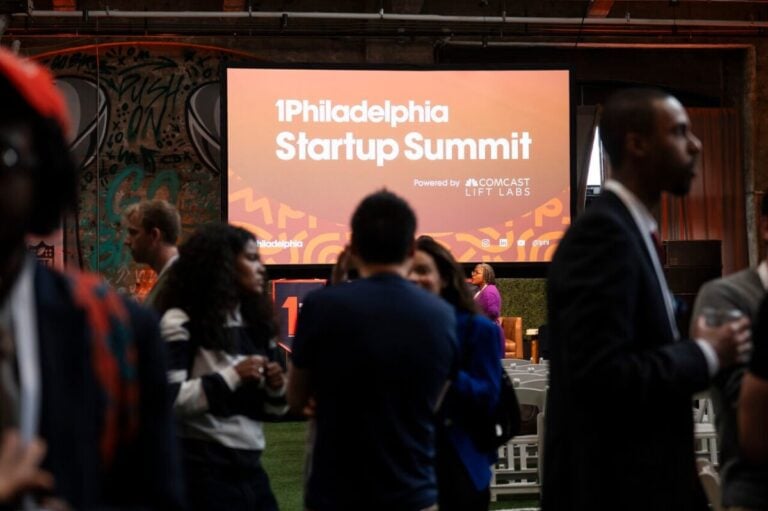
This was originally published here.
The choice of venue for 1Philadelphia’s Startup Summit, a featured event during Philly Tech Week 2026, was intentional.
Ballers is a two-story indoor sports and social club in the Fishtown section of the city with space for members to play pickleball, squash and golf while enjoying food and drinks. It made perfect sense to 1Philadelphia executive director Danae Mobley as the host location for the summit.
“As we’re here today in a space that was built for competition, what does a true win mean for Philly’s tech ecosystem?” Mobley asked during her opening remarks. “Not just that tech exists, but that everyone is able to participate.”
“Culture doesn’t just happen — you have to be intentional.”
Vanessa McGrath, Burro
The sports theme continued throughout the event, with the first “turfside chat” focused on “The Build vs. Buy Signal: How Enterprises Decide.” Victor Williams from NBCUniversal and Helen Gu, founder of InsightFinder, joined moderator Kristina Rahusen in conversation about how enterprise companies decide whether to build or buy technology.
Both panelists emphasized the need to understand overall workflow before deciding, and developing a relationship between enterprise and vendor that goes beyond selling to focus on true partnership.
Being able to pivot is key to startup survival
An audible was called next, with the insertion of a 10-minute lightning talk by Alisa Scharf from Seer Interactive titled “Staying Discoverable in the Age of AI.”
Scharf emphasized how SEO and GEO were fundamentally different systems, and new strategies would be needed to show up in chatbot searches. She stressed that startups were at a disadvantage because “today’s AI are trained on yesterday’s info, so new startups aren’t in the training data for current LLMs.”
The second turfside chat explored “The Invisible Systems Behind Scaling Companies,” featuring Shelton Mercer from Audigent and the Mercer Innovation Group and Vanessa McGrath from Burro, moderated by JPMorgan’s Joseph Biancaniello.
The panelists discussed fundraising, culture and product-market fit. “Culture doesn’t just happen,” McGrath said. “You have to be intentional… and culture can evolve and change if necessary.” And Mercer introduced the idea of PMFP (product-market fit and pivot), where founders have to be nimble enough and humble enough to change course if necessary.
Great execution is the path to competitive advantage
An interactive intermission with startup bingo led into a highlight reel featuring two student founders. Penn student Kawin Leephakpreeda is the founder of decision intelligence startup OceanArbs. Ahyaan Sayed from Drexel is one of the founders of Entropy to Order. Both answered rapid-fire questions about their emerging ventures.
The last turfside chat — “Raising Venture Capital in Practice: Key Decisions and Common Missteps” — featured a lively discussion from Scott Nissenbaum of Ben Franklin Technology Partners, Brett Topche of Red & Blue Ventures and Ellen Weber of Robin Hood Ventures, moderated by Sylvester Mobley of Plain Sight Capital.
The audience walked away with a playbook of do’s and don’ts for their next pitch, with three themes dominating.
First, focusing solely on technology while failing to articulate a clear path to profitability is a major misstep. Second, a startup’s true competitive advantage lies in its execution. And third, securing the right investor is like a marriage — it requires a long-term commitment built on a foundation of relationships and trust. The conversation landed at a telling stat: Philadelphia raised $2.2 billion in venture capital in Q1 2026 alone, though investors at the summit were clear that access to that capital remains uneven.
Right before DJ Diamond Kuts kicked off the happy hour to close the summit, Michelle Cully from the Pennsylvania Department of Community & Economic Development delivered closing remarks that brought the day full circle.
“Startups don’t get built alone,” Cully said, “and Philly is well-positioned with a community that can help you win.”


