
 Blogs
Blogs 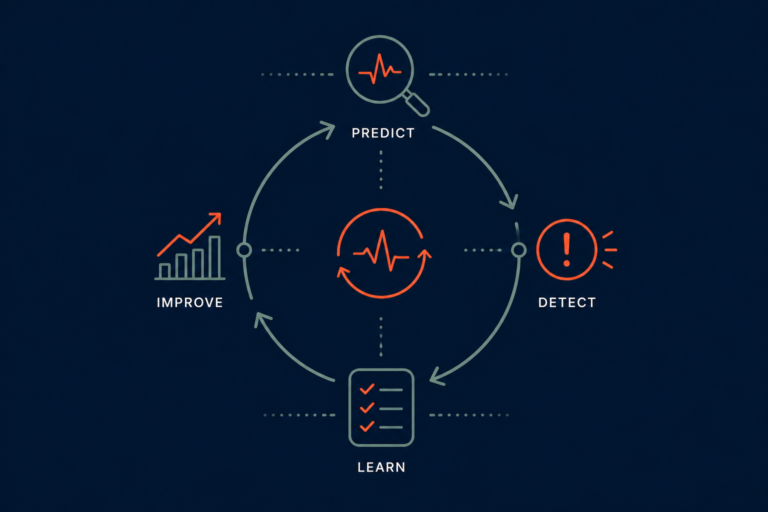
Every reliability team has seen the same story play out. A new “AI-powered” signal ships with a confident demo, gets a few early wins, then fades into the background because on-call engineers stop trusting it. The model may not have been useless. It just didn’t improve in the messy conditions where reliability work actually happens.
That’s the point behind our webinar, “Replacing Rule-Based AIOps with Predictive Reliability Workflows.” Predictive reliability can’t be treated like a one-time deployment. It has to learn from production, adapt as systems change, and capture feedback without making SREs feel like part-time data labelers.
Production Drift Comes for Every Model
Reliability systems don’t stand still. Traffic shifts, services change, dependency paths move, and telemetry evolves as teams add tags, change sampling, or migrate standards. AI applications add even more movement through prompt changes, model upgrades, retrieval updates, and shifting user behavior.
That’s why feedback loops matter. IBM describes model drift as performance degradation caused by changes in data or changes in the relationship between inputs and outputs. In reliability, that’s not an edge case. It’s the normal operating environment.
AWS makes a similar point in its guidance for production generative AI systems, where it emphasizes drift detection, feedback loops, human-in-the-loop controls, and continuous improvement. The lesson applies well beyond GenAI apps: AI systems that operate in production need a way to monitor, learn, and improve without destabilizing the workflow they support.
Feedback Fails When It Feels Like Extra Work
Many AIOps programs stall because feedback collection is too heavy. The tool asks engineers to open another portal, fill out structured forms, classify root causes, or label incidents after the team has already moved on. That might look reasonable in a product requirements document, but it rarely survives a real on-call rotation.
SREs aren’t unwilling to help the system improve. They just won’t tolerate feedback loops that compete with mitigation, customer impact, escalations, and delivery work. The best feedback design respects that constraint from the beginning.
Predictive reliability should capture small signals inside normal work. Was this prediction useful? Was the RCA plausible? Did the suggested action help? Did the team act on the recommendation? Those questions are lightweight, but over time they create a practical learning signal.
Good Feedback Needs Context
A thumbs-down by itself doesn’t improve much. If a responder marks a prediction as unhelpful, the system needs to know what prediction they saw, which evidence was attached, what incident it related to, and what the team eventually learned.
That’s why evidence-rich predictions matter. A useful output should carry its own context: the precursor anomaly, the affected service, the dependency path, the supporting logs or metrics, and the likely impact. Without that linkage, feedback becomes a pile of opinions instead of a path to improvement.
This is where workflow-native design becomes critical. If incident work happens in ServiceNow, Jira, Slack, PagerDuty, or an internal incident portal, feedback should be captured there. When feedback lives in the same place as triage, escalation, and closure, it becomes part of the operating motion rather than a separate labeling program.
Trust Is Measured in Adoption
Model accuracy matters, but it’s not the whole story. A technically accurate prediction can still fail if responders don’t trust it, don’t understand it, or can’t act on it quickly. In reliability, usefulness is the key operational metric.
Teams should measure whether predictions are accepted, whether responders act on them, and whether they reduce time-to-hypothesis. They should also measure false-positive burden as a real cost, because every bad prediction consumes minutes from people who may already be handling customer impact.
Google’s Vertex AI Model Monitoring documentation reflects this broader discipline by treating model quality as something that must be monitored over time, including alerts when drift crosses configured thresholds. Even if a team isn’t using Vertex AI, the operating principle is the same: production model quality can’t be assumed to remain static.
The Feedback Loop Doesn’t Need to Be Heavy
The first version of a predictive reliability feedback loop can be simple. Add one or two feedback fields to the incident workflow. Tie each response to the model output, evidence bundle, incident ID, service, timestamp, and final resolution if one exists.
From there, teams can segment the results. Which services generate the most unhelpful predictions? Which signal types produce the most false positives? Which RCA patterns are accepted quickly? Which recommendations never lead to action?
That review doesn’t need to become a committee ritual. A lightweight weekly review can identify the biggest failure modes and drive targeted improvements: recalibrating models, adding missing telemetry, changing routing rules, improving evidence packaging, or narrowing which signals are allowed to page.
The important part is control. Changes should be validated before they affect on-call. Otherwise, the feedback loop becomes just another source of drift.
Reliability AI that doesn’t learn eventually becomes noise. The system may have been useful when it launched, but production will move. If feedback isn’t captured, evidence isn’t linked, and improvements aren’t validated, trust erodes quietly until engineers stop looking.
That’s why the feedback loop is the product. Predictive reliability earns adoption when it improves through the same workflow where incidents are handled. It shows evidence, captures lightweight feedback, learns from real outcomes, and protects on-call teams from untested changes.
Predictive Reliability Has to Keep Earning Trust
To see how trust fits into a modern AIOps strategy, check out our webinar. To try the approach in your own environment, sign up for InsightFinder and see how predictive reliability can move from static alerts to evidence-backed workflows that improve over time.


