
 Blogs
Blogs 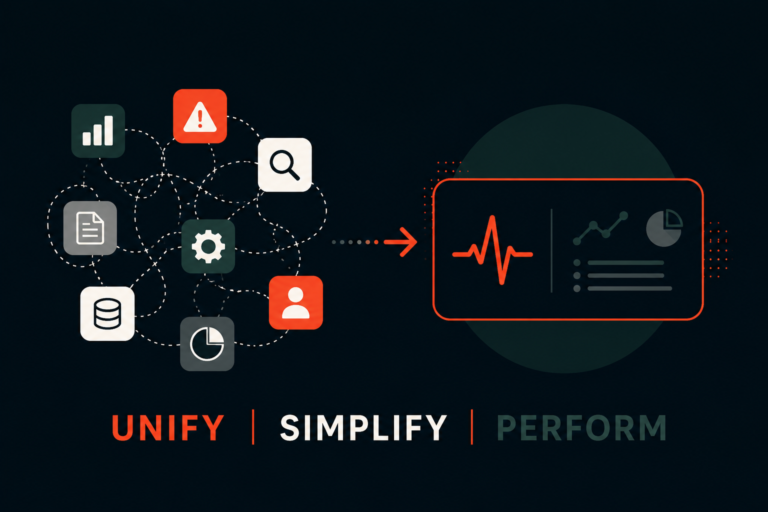
Your systems are on fire. A cascading latency spike is rippling through your payment service, an AI agent is returning hallucinated outputs to customers, and your on-call engineer is context-switching between three different dashboards trying to figure out if these two problems are related. They are. But your tools can’t tell you that.
That’s the hidden cost of the modern reliability stack: not the tools themselves, but the gaps between them.
The split that shouldn’t exist
The reliability tooling market carved itself in half along a fault line that made sense a few years ago and makes almost none today. On one side, you have mature observability platforms built for deterministic systems: metrics, traces, logs, alerts. On the other, a new category of “AI observability” tools has emerged to handle the probabilistic behavior of LLMs and agents, where “correct” isn’t binary and failures look nothing like a 500 error.
Then there’s a third category: operational AI platforms that let you deploy AI agents to do work, like running incident response workflows or auto-remediating known failure patterns.
Each category has capable tools. The problem is that they treat reliability as a set of separate problems, when your users experience it as one.
When a user hits a degraded experience, the cause rarely respects your tooling boundaries. A slow vector database query degrades your RAG pipeline’s retrieval quality, which causes your AI assistant to return worse answers, which increases escalation rates to human support, which spikes your queue times. That chain crosses every category boundary in your stack. Stitching it together manually, across three platforms with different data models and no shared context, costs you the one thing you can’t recover: time.
What “unified” actually means
A unified platform gives your traditional infrastructure and your AI systems a shared data model, so causation flows naturally across both. Your trace data from a microservice call lives alongside the token latency and output quality scores from the LLM call it triggered. An alert on infrastructure degradation automatically contextualizes whether any AI-powered features were affected, and how. A remediation agent operating on your system has full visibility into both layers before it acts, not just the half your legacy observability platform can see.
The difference shows up in the questions you can answer. Did this infrastructure incident affect AI output quality? Is this model’s increased hallucination rate caused by upstream data pipeline latency, or prompt drift? Which reliability improvements will have the largest impact on actual user outcomes, across both deterministic and probabilistic components? Disconnected tools can’t answer those questions. A unified platform can, because the data was never split in the first place.
Tool sprawl has a compounding cost
Every tool you add to your reliability stack adds more than its licensing cost. It adds an integration to maintain, a context switch for every engineer who uses it, a data silo that breaks cross-system correlation, and an onboarding burden for every new team member.
The sprawl problem compounds because reliability is a team sport. When your SRE team works in one platform and your AI/ML engineers work in another, you’ve introduced an organizational boundary that mirrors the tooling boundary. Incidents that cross that line, which is most of the interesting ones, require human coordination to compensate for what the tools can’t do automatically. A unified platform eliminates that coordination tax. Everyone works from the same source of truth, with the same context, whether they’re debugging a container OOM or a model that’s started refusing to answer questions in a specific language.
Probabilistic systems need reliability too, just differently
The reliability practices built for deterministic systems don’t map cleanly onto AI. You can’t define an SLO on “correct answer rate” the same way you define one on p99 latency. LLM outputs exist on a quality spectrum rather than a pass/fail binary. Agents can fail in ways that produce no error code whatsoever: they just do the wrong thing, confidently.
A platform built for both holds both models simultaneously. It applies SLO-style rigor to AI quality metrics alongside traditional infrastructure metrics, treats AI agent actions as observable operations with traces and outcomes, and surfaces reliability signals across the full stack in a single operational view. Your users experience your AI features and your traditional features as one product, and your reliability platform should reflect that.
AI systems are moving from isolated experiments into the critical path of production software. When your AI agent handles customer onboarding, routes support tickets, or makes pricing decisions, its reliability posture matters as much as your database’s. Treating it as a second-class reliability concern, observable only through a separate tool that shares nothing with the rest of your stack, grows more expensive with every percentage point of AI adoption in your product.
Experience the power of unified reliability
The engineers who’ll define the next five years of reliability work will maintain clear visibility across the entire system, traditional and AI alike, and act on that visibility without translating between platforms. InsightFinder is built for exactly that: one platform, one data model, one place where reliability has an answer that covers everything your users actually touch.
Schedule a demo with InsightFinder to see what unified reliability looks like in your stack.


