
 Blogs
Blogs 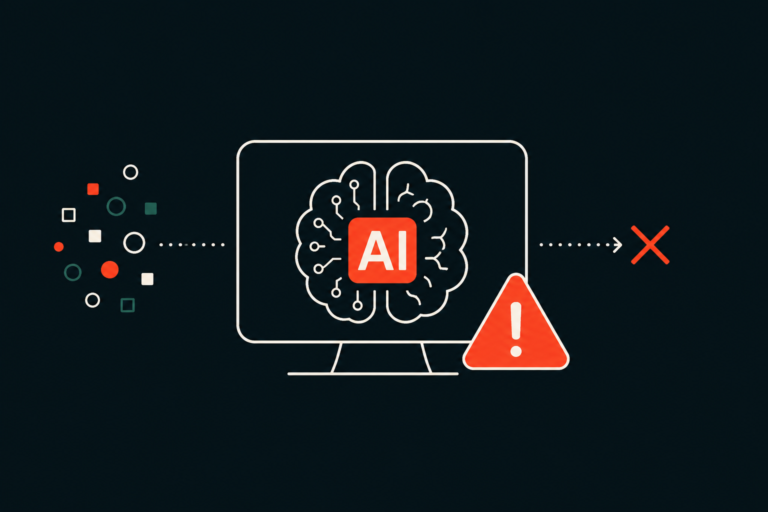
In early 2024, Air Canada’s customer service chatbot told a grieving passenger he could book a full-fare bereavement flight and claim the discounted rate retroactively — a policy that didn’t exist. The airline’s defense was that the chatbot was “a separate legal entity” responsible for its own outputs. A civil tribunal rejected that argument. Air Canada ate the refund, the legal costs, and the press cycle. The system had been “working” the entire time.
No error code fired. No dashboard turned red. That’s the failure mode that’s going to define the next decade of enterprise AI, and most organizations aren’t instrumented to catch it.
This isn’t a bug you can assign a Jira ticket to and patch on Friday afternoon. It’s a foundational reality of math. As InsightFinder CEO Dr. Helen Gu explained on The CTO Show, “Most of the AI under the hood is basically statistical machine learning.” That single fact invalidates a significant portion of how enterprise engineering teams currently think about software reliability.
Deterministic Software vs. Probabilistic AI
Traditional software operates on explicit logic: input X produces output Y, and when it doesn’t, you get an error code. You can write unit tests, achieve code coverage metrics, and assert with confidence that a function either works or it doesn’t. The input space is finite and enumerable. The failure modes are, in principle, exhaustable.
LLMs operate on an entirely different mathematical basis. At inference time, a model is calculating conditional probabilities across high-dimensional vector spaces, selecting the output that maximizes likelihood given the prompt context. There’s no concept of “I don’t know” in that architecture. Ask an LLM about a Windows error code that doesn’t exist, and it won’t return a null or throw an exception. It’ll generate a confident, well-formatted, entirely fabricated resolution, because the path of highest probability runs directly through a plausible-sounding answer. This is the hallucination problem, and it’s not a bug you can patch. It’s a property of how these models work.
Pre-production QA testing cannot contain this. Because the input space for natural language is effectively infinite, code coverage metrics become meaningless. You can test ten thousand prompts and still encounter failure modes you never anticipated once real users start interacting with the system. Research into enterprise AI agent behavior has identified specific failure patterns, including what’s been called an “action-reasoning mismatch,” where a model correctly reasons through a problem internally but executes the wrong command, and then declares success without verifying the outcome. The model doesn’t know it failed. Nothing in your monitoring stack knows it failed.
The Business Cost of Silent Failures
If traditional infrastructure breaks, it screams at you. You see a latency spike, error rates climb, and someone gets paged. Dashboards alert. AI failures return HTTP 200. The system is “working,” in the sense that it’s producing output, but the business logic embedded in that output can be wrong, biased, non-compliant, or actively harmful, and nothing in a standard APM stack will tell you.
This is serious enough for single-agent deployments. It compounds exponentially in multi-agent architectures. When a routing agent makes a statistically probable but factually wrong decision, that decision propagates downstream to execution agents that treat it as ground truth. Errors move at machine speed, across business units, without the friction of human review that would normally catch them. And as Helen Gu points out, you can hold a human operator accountable through organizational culture. You can’t reprimand an autonomous agent that drained your ad budget or leaked sensitive IP because of a hallucination nobody monitored for.
Model drift adds another layer. The foundational models enterprises build on, Anthropic, OpenAI, Gemini, are continuously updated by their providers. Model behavior changes. The same prompt that returned one answer yesterday may return a different answer tomorrow, not because your system changed, but because the underlying model did. Without drift detection, you won’t know whether a shift in business outcomes is coming from your data, your infrastructure, or a silent change in model behavior.
The Framework for Runtime AI Observability
Standard APM tools, the CPU utilization graphs and memory allocation charts, are blind to this class of failure. Monitoring AI in production requires evaluation at a fundamentally different granularity. Every prompt, every retrieval step in a RAG pipeline, every model response needs to be assessed in real time against criteria that traditional observability never needed to consider: factual accuracy, hallucination boundaries, PII and IP leakage, bias and fairness drift, and compliance posture.
When we looked at how to actually build this at InsightFinder, we realized the evaluation has to happen at the conversation level, not just the log level. If you aren’t outputting a clear pass/fail signal across dimensions like bias or PII leakage in real-time, you’re flying blind. That’s why our devs built the InsightFinder AI Reliability Platform to tie runtime anomaly detection to remediation workflows and fine-tuning pipelines, closing the loop between production failure and model improvement automatically.
The pre-production side matters too. Before a model configuration goes to production, teams should be running systematic prompt comparisons across model versions, datasets, and evaluation criteria to establish a baseline of what “working correctly” actually means for their specific use case. That baseline is what makes runtime drift detectable. Without it, you’re monitoring against nothing.
The Shift That Separates Leaders from Laggards
Air Canada had one chatbot. Most enterprises deploying AI today are building something far more complex. A loan pre-qualification agent hallucinates a favorable debt-to-income interpretation and passes it downstream to an underwriting agent, which approves the file, which triggers a compliance agent to file disclosures. By the time a human reviews anything, three systems have acted on a wrong premise and generated a paper trail that’s expensive to unwind. The loan just moved; silently, smoothly, and completely incorrect.
The distinguishing factor between organizations that operationalize AI successfully and those that don’t isn’t how fast they shipped. It’s whether they instrumented production before something went wrong rather than after.
The SRE discipline emerged because “it works on my machine” stopped being an acceptable standard for distributed systems. AI reliability is the same inflection point, applied to a harder problem. The input space is larger, the failure modes are quieter, the blast radius of a multi-agent error is wider, and the foundational models you depend on are changing underneath you without notice.
Organizations that build runtime evaluation and closed-loop fine-tuning into their AI operations from the start can catch, diagnose, and correct failures before they become incidents — and continuously improve model performance against real production data rather than static benchmarks. The ones that don’t will eventually absorb a failure their tooling never saw coming, and spend the aftermath reverse-engineering what went wrong.
The infrastructure for doing this exists now. If you want to see what it looks like against your own prompts and your own data, try the InsightFinder AI Sandbox and start with the workflows that matter most to your team.


