
 Blogs
Blogs 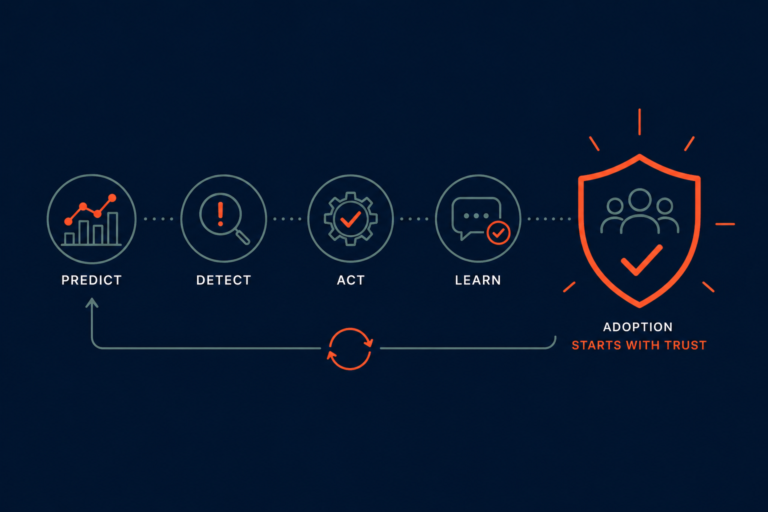
Most teams don’t reject predictive reliability because they’re skeptical of AI in theory. They reject it because they’ve been burned by noisy automation in practice. Incident response is a bad place to introduce a signal that’s vague, late, or hard to validate.
That’s the adoption problem behind our webinar, “Replacing Rule-Based AIOps with Predictive Reliability Workflows.” The webinar makes a practical point: predictive reliability can’t succeed as a clever model bolted onto alerting. It has to earn trust as a workflow, with evidence, human validation, and delivery inside the tools teams already use.
On-Call Trust Is Hard to Win
On-call teams work in a credibility economy. Every false positive spends trust. Every vague “risk detected” message costs time. Every recommendation that requires five minutes of manual validation competes with the real work of restoring service.
That’s why predictive reliability often fails after a promising demo. In the demo, the model looks insightful. In production, responders ask harder questions. What changed? Why does this matter? What’s the likely impact? What should we do first?
Google’s incident management guidance is useful here because it frames incident response around reducing cognitive load, coordinating execution, and supporting mitigation. Automation helps when it gives responders better analysis or action guidance. It hurts when it adds another unclear signal to interpret during an already stressful event.
Don’t Ask Engineers to Trust What They Can’t Validate
A prediction that says, “Incident likely in two hours, confidence 0.82,” may look sophisticated. It’s still not enough. Engineers don’t act on probability scores during incidents. They act on evidence they can verify.
A useful prediction should arrive with the reason it exists. It should show precursor anomalies, where they appeared, how they relate across services or dependencies, and what operational impact may follow. It should also suggest what to investigate first or which mitigation path is safest.
This is where predictive reliability differs from basic incident prediction. A forecast is just a warning. A workflow gives teams evidence, prioritization, and a path to action.
Earn the Right to Page
The safest adoption pattern is simple: don’t let prediction page humans until it has earned that right. Teams should start by testing predictive reliability against historical incidents. Replay telemetry in time order and ask whether the system would’ve surfaced the right signal early enough to change the response.
Once the historical review shows value, run the system in shadow mode. Let it generate predictions in production without waking anyone up. Route the output to a signals channel, an internal dashboard, or an ITSM note where teams can inspect quality without changing on-call behavior.
Only then should teams move to human-in-the-loop triage. A small group, usually primary on-call plus a lead or incident manager, can decide whether a prediction is actionable enough to escalate. Controlled paging should come last, and it should start with a narrow scope, high-confidence scenarios, and an evidence bundle attached to every page.
This rollout protects the most important asset in incident response: responder trust.
The Moment Predictive AIOps Becomes Real
Trust usually clicks when the system catches something the team recognizes. A prediction flags a deployment regression before customers complain. It points to the right dependency when the symptoms are scattered across services. It gives responders a credible first hypothesis instead of another dashboard to inspect.
Those moments matter because they turn predictive AIOps from an abstract AI feature into an operational teammate. The system doesn’t need to be treated like an oracle. It needs to be treated like a fast analyst that brings evidence early and helps humans decide where to start.
Google Cloud’s alerting guidance makes a related point: signals should be designed around relevance and intended outcomes. In practice, that means a prediction matters when it changes a decision, not when it merely looks accurate after the fact.
Measure Outcomes, Not Just Model Scores
Predictive reliability adoption fails when teams measure only the model and forget the workflow. Accuracy matters, but operational usefulness matters more. Leaders should ask whether predictions helped responders act faster, avoid escalation, or form a better hypothesis.
Usefulness rate is often the best early signal because it captures whether engineers found the prediction worth their attention. Actionability matters because an early warning that doesn’t change behavior is just another siren. False-positive burden matters because every unhelpful prediction consumes responder minutes.
Lead time matters most when it applies to meaningful incidents. A prediction that arrives early enough to help a team reduce customer impact is far more valuable than a high-scoring signal that never affects the response.
Workflow-Native Delivery Builds Confidence
Even good predictions get ignored if they live in the wrong place. During incidents, teams work in paging tools, incident channels, ITSM tickets, runbooks, and war rooms. If predictive context sits in a separate console, it becomes an artifact people review later.
Prediction becomes useful when it lands where decisions are made. In a ServiceNow-heavy organization, that may mean enriching the incident record with likely causes, precursor evidence, and next-step guidance. In a chat-driven team, it may mean bringing the same context into the incident channel with links back to supporting telemetry.
This is why we’ve built predictive reliability that matters. InsightFinder treats prediction as part of incident response, not as a standalone score. The goal is to help teams see weak signals earlier, validate them quickly, and act inside the workflow they already trust.
Predictive reliability doesn’t become operational because a model says it’s confident. It becomes operational when teams can prove value on historical incidents, run safely in shadow mode, validate evidence, control paging scope, and improve through feedback.
That’s the modern take on AIOps: evidence-backed prediction delivered in the flow of incident response, with enough context for engineers to trust what they’re seeing.
Make Predictive Reliability Worth Trusting
To see the full adoption model, check out our webinar. To evaluate it in your own environment, sign up for free and see how predictive reliability can help your team move from noisy automation to evidence-backed action.


