
 Blogs
Blogs 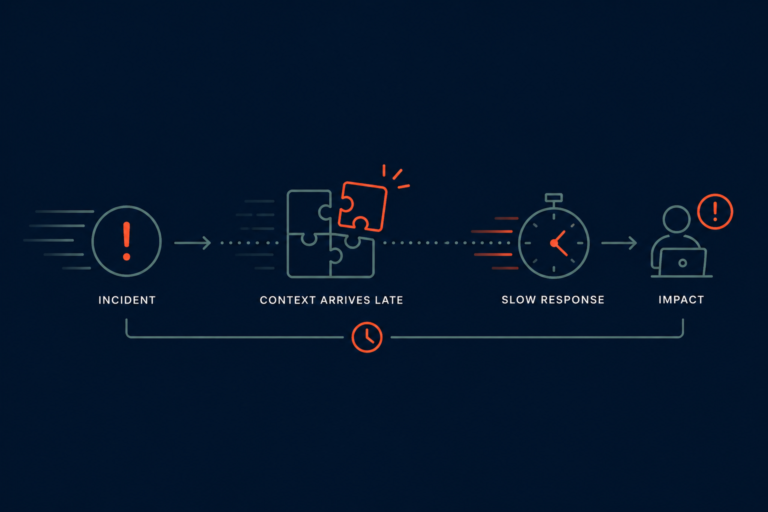
Most enterprises don’t have a monitoring shortage. They’ve got APM, logs, traces, cloud dashboards, infrastructure metrics, SIEM tools, and usually at least one AIOps layer. Yet when a serious incident hits, responders still fall into the same pattern: open the ticket, hunt across dashboards, ask what changed, find ownership, paste screenshots into chat, and form a useful hypothesis too late.
That goes beyond a tooling problem: it’s a workflow problem. The context exists somewhere, but it doesn’t arrive where responders need it at the moment action is required.
This is a core theme in our webinar, “Replacing Rule-Based AIOps with Predictive Reliability Workflows.” The point isn’t to add another investigation console. It’s to move root cause context, evidence, and recommended actions into the incident workflow teams already use.
Dashboards Don’t Resolve Incidents
Dashboards are useful before and after incidents. During a live outage, they’re often another place to search. Responders are coordinating teams, communicating impact, and trying to stabilize service. They don’t have time to wander through a dozen screens to assemble the story by hand.
Google’s Incident Management Guide frames incident response around the “three Cs”: coordinate, communicate, and control. That’s a useful reminder that incidents aren’t won by exploration. They’re won through structured execution, clear ownership, and fast mitigation.
In many enterprises, that execution happens inside an ITSM platform such as ServiceNow or Jira, plus the incident channel and escalation path. If RCA context stays trapped in a separate console, it may be technically correct and still fail to change the first fifteen minutes of response.
Alert Consolidation Isn’t Enough
Many AIOps deployments start by reducing alert noise. That’s a reasonable first step. Fewer duplicate pages and cleaner incidents can make operations feel less chaotic.
But the plateau comes quickly. The incident ticket may be cleaner, yet responders still don’t know what changed first, what’s causal, what’s downstream, who owns the likely failure domain, or what action to take first. Grouping alerts doesn’t automatically create a hypothesis engineers trust.
This is where Google Cloud’s operational guidance is helpful. Its Operational Excellence guidance for incidents and problems emphasizes centralized incident management, post-incident reviews, knowledge bases, and automation. Those ideas point to a practical truth: the system of record has to carry more than a ticket number. It has to carry actionable context.
ITSM-Native RCA Changes the First Fifteen Minutes
The fastest path to MTTR impact often starts with better incident records. When RCA enrichment lands inside the ticket, responders don’t have to reconstruct the situation from scratch. They can begin with a ranked hypothesis, evidence, ownership hints, blast radius, and recommended next steps.
That changes the tone of the incident. Instead of asking five teams whether they’ve seen anything unusual, the responder can validate a specific hypothesis. Instead of scanning dashboards for a starting point, they can inspect the evidence trail already attached to the incident. Instead of guessing ownership, they can engage the team most likely tied to the affected dependency.
Good enrichment doesn’t say “root cause: latency.” That’s not helpful. It says the likely upstream issue is a dependency regression after a deployment, supported by rising retry rates, queue depth growth, trace latency, and related log patterns. That’s the kind of context engineers can test quickly.
A Checkout Incident With and Without Context
Let’s say we have a checkout latency incident that opens in ServiceNow at 2:10 PM. The default ticket says latency is elevated, but ownership is unclear. The on-call engineer opens APM, checks logs, scans traces, asks the platform team about infrastructure, and pulls the payments team into the channel just in case.
Eventually someone notices retry volume increased after a deployment. A downstream queue had been growing for nearly an hour, but it didn’t become obvious until timeouts spiked. The team rolls back the change, but not before the first hour disappears into orientation and coordination.
Now imagine the same incident with ITSM-native RCA. The ticket arrives with a ranked hypothesis that points to a downstream dependency regression. It shows the first anomaly timestamp, the trace span where latency accumulated, the logs showing elevated retries, and a queue-depth trend that started before the alert fired. It also suggests a rollback path or feature flag check, with a runbook link.
The difference is much more than cosmetic. In the second version, responders start with a testable theory. They can validate faster, engage the right owners, and take a safer first action.
Workflow Gravity Decides Adoption
Even strong analysis fails if it lives where responders aren’t working. During an incident, attention collapses toward the system of record, the incident channel, and the escalation path. Tool-hopping adds cognitive load at exactly the wrong moment.
That’s why integrations aren’t a checkbox. They’re often the adoption gate. ServiceNow’s Integration Hub documentation describes reusable integrations with third-party systems that can be called from across the ServiceNow AI Platform, which reflects the broader enterprise reality: workflow platforms are meant to orchestrate work, not sit beside it.
For predictive reliability, this matters because the output has to become operational. RCA evidence, blast radius, ownership, and next actions need to appear where decisions are made. Otherwise, AI-powered analysis becomes another artifact people review after the incident.
If incident response is slow, the problem may not be missing telemetry. It may be missing context at the moment of action. The signals exist, but they’re fragmented across tools and delivered too late to shape the response.
Modern AIOps should change that. It should use multi-modal telemetry to detect early anomalies, connect evidence across systems, generate credible RCA hypotheses, and deliver those findings inside the incident workflow. That’s what makes predictive reliability different from alert correlation. It doesn’t just make noise easier to manage. It makes the next action easier to see.
Modern AIOps Has to Meet the Workflow
To see how modern AIOps fits into your workflows, check out our webinar. Or, to try this approach in your own environment, sign up for InsightFinder and see how modern AIOps can bring evidence-backed RCA into the workflows your responders already trust.


