
 Blogs
Blogs 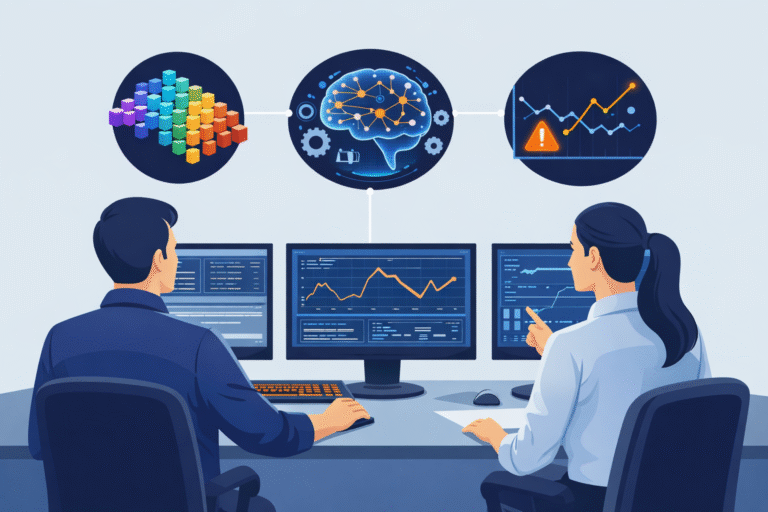
Composite AI observability is the practice of combining several AI techniques, including unsupervised anomaly detection, causal inference, predictive modeling, and generative AI, so each method handles the observability task it does best across metrics, logs, traces, and events.
Every enterprise feels the impact of AI. For teams that run complex infrastructure, though, something crucial is missing from the generative AI conversation. Business leaders understand the promise of language models. They still ask one question: can generative AI alone make sense of our machine data, root out anomalies, and help us act fast when the next incident hits?
This post explains why generative AI is one part of a larger system. You will learn what composite AI observability means in plain terms, how observability tools actually analyze machine data, where generative AI falls short, and how enterprises deploy a layered approach for measurable results, including in air-gapped and compliance-heavy environments.
What Composite AI Observability Means
The term “composite AI” comes from Gartner, which defines it as “the combined application of different AI techniques to improve the efficiency of learning to broaden the level of knowledge representations and, ultimately, to solve a wider range of business problems in a more efficient manner.” Gartner also placed composite AI on its Hype Cycle for Artificial Intelligence, 2021 (Gartner IT Glossary).
Applied to IT observability, the idea is straightforward. No single model detects, explains, and predicts issues across the full range of machine data an enterprise produces. A composite approach assigns each job to the technique best suited to it, then connects the results.
Why Generative AI Alone Is Not Enough for IT Observability
Generative AI models like ChatGPT made AI visible to the broader public. Their ability to predict and generate human language changed how people interact with software. These models are optimized for natural language, which is structured, rule-driven, and, in relative terms, predictable.
The data that IT and engineering teams work with is different in kind. IT environments produce a torrent of machine data: numerical time series, categorical values, logs, semi-structured and unstructured information, and telemetry from network devices. Observability depends on signals such as:
- Numerical time-series metrics
- Logs and semi-structured events
- High-cardinality categorical values
- Network and infrastructure telemetry
This data is noisy, high-dimensional, and highly dynamic, which makes it poorly suited for language-only models.
The mismatch has real consequences. A model that excels at generating text can miss the hidden relationships and critical outliers buried in infrastructure telemetry. That is why techniques like clustering, anomaly detection, and causal inference stay central to observability even as generative AI makes headlines. The next section walks through how those techniques work before we look at how InsightFinder applies them.
How Observability Tools Analyze Machine Data
Set aside any specific vendor for a moment. Any serious observability tool has to answer three questions about machine data: what is wrong, why it is wrong, and what will go wrong next. Each question maps to a distinct branch of machine learning.
Detection. The first problem every engineer faces is knowing when something is wrong. Anomaly detection is the foundation. Labeling machine data for supervised learning is impractical at enterprise scale, because no team can annotate every log line or metric spike. Unsupervised learning fills the gap by scanning large datasets, identifying unusual patterns, and flagging anomalies without human labels. Anomaly detection is a mature, cross-domain machine learning problem, surveyed as far back as the 2009 ACM Computing Surveys paper by Chandola, Banerjee, and Kumar (ACM Computing Surveys, 2009). That reference predates modern deep learning, but it established anomaly detection as a general technique that applies well beyond IT.
Explanation. Detection alone does not solve the problem. Engineers need to know why an anomaly occurred. Root cause analysis, understanding which events are related and how, calls for causal inference. Causal methods connect disparate alerts, performance shifts, and upstream or downstream impacts, and they surface relationships that standard correlation analysis misses. Research supports the distinction: CausalRCA, published in the Journal of Systems and Software, 2023, showed that causal inference outperforms correlation-only baselines for fine-grained root cause localization in microservice applications. Those are strong experimental results, not a claim that causal AI is a settled industry standard.
Prediction. The third question is what happens next. Predicting incidents before they reach users is the hardest of the three. Predictive modeling on machine data is harder than on language or tabular business data. Patterns are cyclic and bursty, and some are unique to a single system. Effective predictive models adapt to seasonal, trending, and outlier-driven behavior inside one dataset.
No single AI technology fits all three needs. Detection, explanation, and prediction each demand an approach tuned to the idiosyncrasies of the environment. That is the general case for composite AI, independent of any product.
The Limits of Foundation Models in the Enterprise
Reliance on generative AI alone becomes risky here. Foundation models are trained on generic datasets and optimized for broad coverage. In enterprise observability, that generalization turns into a liability, because infrastructure data, workflows, and failure modes are organization-specific and often absent from public training data.
The evidence points the same way. Across specialized domains including time series, the closest analog to IT metrics, simple supervised models consistently matched or outperformed large foundation models, according to a 2024 CMU preprint by Xu and colleagues (arXiv:2411.02796). The finding is a preprint on time series rather than IT telemetry directly, but the direction is clear: for narrow, domain-specific tasks, a targeted model often wins.
Reliability of the generated answer matters too. Deploying a generative AI chatbot to handle support tickets looks like a shortcut, yet a model that hallucinates an answer or confidently offers incorrect guidance raises the stakes. On a targeted open-domain question-answering benchmark, ChatGPT produced hallucinated or unverifiable content in about 19.5% of responses, per the HaluEval study presented at EMNLP 2023 (arXiv:2305.11747). That figure comes from open-domain QA, not IT telemetry, and rates vary by domain, so treat it as a signal rather than a universal rate. As InsightFinder CEO Helen Gu has put it, foundation models are often “confidently wrong.” Unlike a human expert, they rarely admit uncertainty.
The risk is concrete. Consider support automation for a Windows device vendor. A customer reports a specific error code, and the generative AI model draws on general knowledge instead of the vendor’s proprietary troubleshooting data. It offers inaccurate steps, the operator trusts the system and acts on that advice, and the problem escalates.
Composite AI addresses this by combining generative AI with specialized models tuned to your environment. The result is greater accuracy, less guesswork, and enough confidence to automate workflows without losing control.
Composite AI: A Hierarchical Approach
Think of composite AI observability as a hierarchy of tools, each chosen for its strengths:
- Anomaly detection (unsupervised AI) surfaces problems early, with no labeled data required.
- Causal AI uncovers the relationships and root causes that matter for remediation.
- Predictive AI anticipates future incidents, but only when the underlying detection and causal analysis are accurate.
- Generative AI translates technical findings into human-friendly language so operators and decision makers can act fast.
This layered approach answers the “black box” perception of AI. Instead of a crystal ball delivering mysterious outputs, composite AI offers explainability. It can show why a specific alert fired, trace its root cause across hundreds of interdependent signals, and forecast likely outcomes, all while summarizing results in language the business understands.
What’s Most Overlooked: The Hidden Value of High-Quality Alerts
Many organizations focus narrowly on reducing alert volume. Alert reduction only helps if the remaining alerts are high quality. Cutting thousands of false alarms down to a handful still leaves engineers in the dark when none of those alerts point to the real root cause.
The real goal is to surface meaningful anomalies. Unsupervised AI does the heavy lifting, discovering outliers that humans would otherwise miss. With accurate detection in place, causal inference makes sense of complex incident chains. When that foundation is solid, predictive AI delivers insights that teams previously ignored or undervalued.
There is a reason many technology leaders stay skeptical about predictive AI. Years of “AIOps” tools taught them to expect little: garbage in, garbage out. A disciplined composite approach changes the outcome. InsightFinder customers regularly uncover business value from predictive insights, thanks to the accuracy of their detection and causal analysis layers.
The Business Case for Secure, Air-Gapped AI
For many enterprises, the conversation does not stop at capability. Security and data sovereignty are equally pressing. The ability to deploy AI on-premises, or inside an air-gapped environment, delivers control that goes past compliance checkboxes. Enterprises in regulated sectors such as healthcare, finance, and critical infrastructure need to know where their data lives, who can access it, and how it is used.
Running AI in a truly isolated environment provides operational sovereignty. Sensitive or proprietary data never leaves your infrastructure. No model training, inference, or support activity is exposed to third parties. This is about more than regulatory risk. It reduces the surface area for unintended data leakage and internal misuse, which is a competitive advantage as much as a compliance requirement.
Why Data Quality Decides the Outcome
The stakes behind a composite approach are financial as well as technical. Downtime is expensive: the ITIC 2024 Hourly Cost of Downtime Survey reported that a single hour of downtime now exceeds $300,000 for over 90% of mid-size and large enterprises, and that 41% of enterprises put hourly downtime costs at $1 million to over $5 million (ITIC, 2024). That survey is self-reported across more than 1,000 firms from November 2023 through March 2024, so read it as directional, but the direction is unambiguous.
Weak data and weak controls undercut AI programs before they deliver. Gartner predicts that at least 30% of generative AI projects will be abandoned after proof of concept by the end of 2025, citing poor data quality, inadequate risk controls, escalating costs, or unclear business value (Gartner, July 29, 2024). That is a prediction rather than a confirmed outcome, and it points to the same lesson: accurate detection and causal analysis, grounded in your own data, are what make the generative layer trustworthy.
The Takeaway: Composite AI Delivers Measurable Results
Composite AI observability is a pragmatic response to the real-world challenges IT and ML engineers face. By matching the right AI technique to each layer of the observability stack, enterprises detect, explain, and anticipate issues with accuracy and transparency that single-model approaches cannot deliver.
Relying only on generative AI for observability or automation carries real risk. The enterprises that succeed recognize the unique constraints of their environment and deploy AI as a composite, layered system that stays explainable and tunable while aligning to the needs of their data.
Ready to see the difference composite AI can make for your organization? Schedule live demo and experience next-generation observability designed for enterprise reality.


