
 Blogs
Blogs 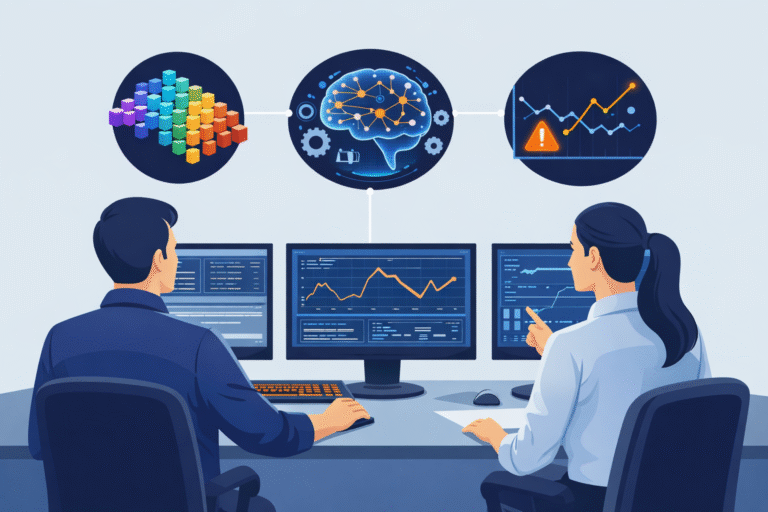
Composite AI refers to the use of multiple AI techniques, such as unsupervised learning, causal inference, predictive modeling, and generative AI, applied together, with each used where it is most effective. In IT observability, composite AI enables teams to detect, explain, and respond to issues across complex machine data that no single model can handle alone.
Every enterprise feels the impact of AI. But for those who run complex infrastructure, there is a growing sense that something crucial is missing from the Gen AI conversation. Business leaders understand the promise of language models. Yet they are left asking: can Gen AI alone make sense of our machine data, root out anomalies, and help us act—fast—when the next incident hits?
This post explores why Gen AI is just one part of a much larger puzzle. I’ll explain what composite AI is, why it matters for IT observability, and how leading enterprises are thinking about deploying it for measurable results.
What You’ll Learn
We’re breaking down what composite AI means in plain terms, why it is essential for making sense of modern IT data, and where Gen AI often falls short. You’ll see why composite AI unlocks a new class of automation and accuracy that goes beyond the capabilities of any single AI technique. And I’ll share the business-critical value of deploying AI securely—especially in air-gapped and compliance-heavy environments.
Why Generative AI Alone Is Not Enough for IT Observability
Gen AI models like ChatGPT have made AI visible to the broader public. Their ability to predict and generate human language has revolutionized interaction. However, these models are optimized for natural language data that is structured, rule-driven, and, in relative terms, predictable.
In practice, the data that IT and engineering teams must work with is fundamentally different. IT environments produce a torrent of machine data: numerical time series, categorical values, logs, semi-structured and unstructured information, telemetry from network devices, and more. The volume and variability of this data are staggering. Unlike human language, machine data is often noisy, high-dimensional, and filled with subtle fluctuations and patterns that defy easy prediction:
In practice, the data that IT and engineering teams must work with is fundamentally different. IT observability depends on machine data such as:
- Numerical time-series metrics
- Logs and semi-structured events
- High-cardinality categorical values
- Network and infrastructure telemetry
This data is noisy, high-dimensional, and highly dynamic—making it poorly suited for language-only models.
This matters because the tools that work for one kind of data can fail badly on another. An AI model that excels at generating text may miss the hidden relationships or critical outliers buried in your infrastructure telemetry. That is why techniques like clustering, anomaly detection, and causal inference remain central to observability—even as Gen AI makes headlines.
The Real-World Demands of IT Observability
The first problem every engineer faces is simply knowing when something is wrong. Anomaly detection is the foundation. But labeling machine data for supervised learning is impossible at an enterprise scale. You cannot hire enough humans to annotate every logline or metric spike. This is where unsupervised learning comes in.
Unsupervised models can scan massive datasets, identify unusual patterns, and flag anomalies without human intervention. Yet traditional clustering algorithms struggle with the sheer dimensionality and complexity of real-world IT data. At InsightFinder, we’ve developed high-dimensional, highly scalable anomaly detection algorithms—capable of identifying issues that simpler techniques miss. This is not just academic; it is the difference between catching an outage early and getting lost in a sea of noise.
But detection alone does not solve the problem. Engineers must know why an anomaly occurred. Root cause analysis—understanding which events are related and how—requires a different kind of AI: causal inference. Causal AI connects the dots between disparate alerts, performance shifts, and upstream or downstream impacts. It uncovers relationships that are invisible to standard correlation analysis, especially in dynamic, real-time environments.
Finally, there is a prediction. In a world where downtime costs real money, predicting incidents before they impact users is the holy grail. Predictive AI for machine data is fundamentally more difficult than for language or tabular business data. Patterns are cyclic, bursty, and sometimes unique to each system. Effective predictive models must adapt to seasonal, trending, and outlier-driven behavior—often within the same dataset.
The reality is that no single AI technology fits all needs. Each task—detection, explanation, prediction—demands its own approach, tuned to the idiosyncrasies of your environment.
The Limits of Foundation Models in the Enterprise
Here is where reliance on Gen AI becomes risky. Foundation models are trained on vast, generic datasets and optimized for broad coverage. In enterprise observability, this generalization becomes a liability. Infrastructure data, workflows, and failure modes are organization-specific and often invisible to public training data.
Deploying a Gen AI chatbot to handle support tickets may seem like a shortcut, but if that model hallucinates an answer—or confidently offers incorrect guidance—the stakes are high. In production environments, bad AI advice can lead to downtime, compliance violations, or lost revenue. In a recent interview with InsightFinder CEO, Helen Gu put it, foundation models are often “confidently wrong.” Unlike a human expert, they rarely admit uncertainty.
This is not an abstract concern. Consider the example of support automation for a Windows device vendor. If a customer reports a specific error code and the Gen AI model draws on general knowledge instead of the vendor’s proprietary troubleshooting data, it may offer entirely inaccurate steps. The operator, trusting the system, acts on that advice—and the problem escalates.
That is why composite AI matters. It combines the strengths of Gen AI with specialized models tailored to your environment. The result is greater accuracy, less guesswork, and the confidence to automate workflows without losing control.
Composite AI: A Hierarchical Approach
Think of composite AI as a hierarchy of tools, each chosen for its strengths. Anomaly detection (unsupervised AI) surfaces problems early, without the need for labeled data. Causal AI uncovers the relationships and root causes that matter for remediation. Predictive AI anticipates future incidents—if, and only if, the underlying detection and causal analysis are accurate. Gen AI then translates technical findings into human-friendly language, empowering operators and decision makers to take action fast.
This layered approach solves the “black box” perception of AI. Rather than a crystal ball delivering mysterious outputs, composite AI offers explainability. It can show why a specific alert was triggered, trace its root cause across hundreds of interdependent signals, and forecast likely outcomes—all while summarizing results in language the business can understand.
What’s Most Overlooked: The Hidden Value of High-Quality Alerts
Many organizations focus narrowly on reducing alert volume. But alert reduction is only valuable if the remaining alerts are high quality. Reducing thousands of false alarms to a handful still leaves engineers in the dark if none of those alerts point to the real root cause.
The real goal is to surface meaningful anomalies. Unsupervised AI plays a critical role here, discovering outliers that humans would otherwise miss. With accurate detection, causal inference can then make sense of complex incident chains. When this foundation is solid, predictive AI comes into its own—delivering insights that were previously ignored or undervalued.
There is a reason many technology leaders are skeptical about predictive AI. Years of “AIOps” tools have trained them to expect little: garbage in, garbage out. But with the right composite approach, the game changes. InsightFinder customers regularly uncover business value from predictive insights, thanks to the accuracy of their detection and causal analysis layers.
The Business Case for Secure, Air-Gapped AI
For many enterprises, the conversation does not stop at capability. Security and data sovereignty are equally pressing. The ability to deploy AI on-premise, or within an air-gapped environment, delivers control that goes well beyond compliance checkboxes. Enterprises in regulated sectors—healthcare, finance, critical infrastructure—need to know where their data lives, who can access it, and how it is being used.
Running AI in a truly isolated environment provides operational sovereignty. It means sensitive or proprietary data never leaves your infrastructure. No model training, inference, or support activity is exposed to third parties. This is not only about regulatory risk. It’s about reducing the surface area for unintended data leakage or internal misuse. In today’s world, that is a competitive advantage as well as a compliance requirement.
The Takeaway: Composite AI Delivers Measurable Results
Composite AI is not just a buzzword; it is a pragmatic response to the real-world challenges faced by IT and ML engineers. By matching the right AI technology to each layer of the observability stack, enterprises can detect, explain, and anticipate issues with a level of accuracy and transparency that single-model approaches cannot deliver.
Relying solely on Gen AI for observability or automation is a risk. The enterprises that succeed are those that recognize the unique challenges of their environment and deploy AI as a composite, layered system—one that is explainable, tunable, and, most importantly, aligned to the needs of their data.
Ready to see the difference composite AI can make for your organization?
Request a free trial at InsightFinder.com and experience next-generation observability designed for enterprise reality.


