
 Blogs
Blogs 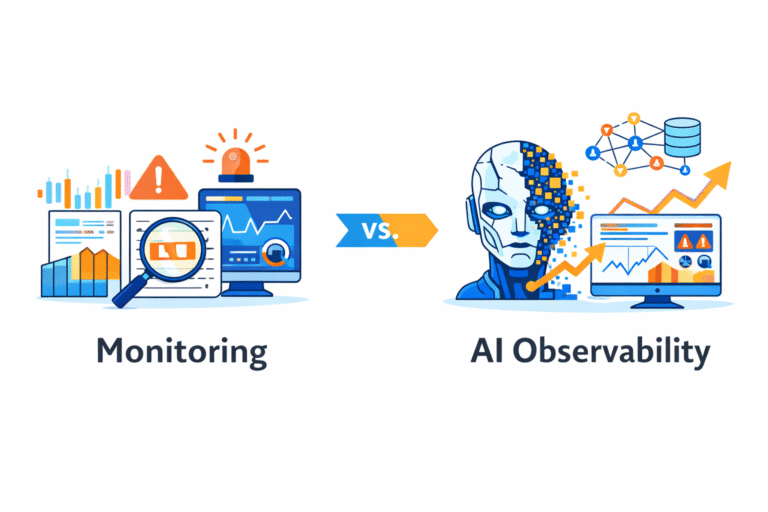
Many engineering teams still use the terms “monitoring” and “observability” interchangeably. At first glance, the overlap seems obvious because both involve understanding system behavior. The truth is that they serve different purposes and come with different expectations. The difference matters because modern cloud systems behave nothing like the static environments these tools were first built for. The noise level in distributed systems, container orchestration platforms, and multi-cloud architectures grows every year, and teams often rely on reactive processes that cannot keep up.
The progression is straightforward. Monitoring provides reactive awareness. Observability offers proactive insight. AI observability is extended by adding predictive intelligence. By understanding where each approach fits, engineering leaders can choose a path that matches the demands of their environments and the maturity of their operations.
Why the Difference Between Monitoring and Observability Matters
Teams often assume these approaches solve the same problems. In practice, the distinction impacts reliability, time to resolution, and how quickly engineers understand unfamiliar incidents. The line between them becomes even more important as cloud environments shift toward ephemeral runtimes, distributed dependencies, and unpredictable interactions that make simple alerting insufficient.
How Cloud-Native Complexity Has Outgrown Traditional Monitoring
Monitoring was designed for stable servers and predictable traffic patterns. Modern systems behave differently. Microservices move constantly, containers come and go, and services in different clouds interact in ways that cannot be mapped cleanly. Threshold-based checks cannot describe these systems. They raise alarms when something crosses a predefined boundary, but they do not explain the behavior that caused it. Dynamic systems need deeper insight than static limits can provide.
Why Alerts Alone Can’t Keep Up With Distributed Systems
Threshold-based alerts usually fire after a customer feels the impact. When hundreds of components generate thousands of signals, teams face alert fatigue long before they find the signal that matters. Alerts lack context because they only describe the symptom. They do not describe the story behind it, and they do not show how one service’s degradation cascaded to another. Recovery slows because engineers must reconstruct the timeline manually.
The Evolution From Reactive to Proactive to Predictive IT Ops
Monitoring reacts to events. Observability helps teams proactively explore the evidence behind them. AI observability extends this evolution by predicting problems before symptoms become visible. This framework offers a clear way to classify operational maturity and helps teams understand where to invest next as workloads become more complex.
What Is Monitoring? The Reactive Foundation of System Awareness
Monitoring still plays a crucial role even as architectures evolve. It offers the basic signals that reveal when a system crosses an established boundary. Its value lies in its simplicity. The limits become clear, and the triggers are easy to define. But that simplicity also constrains its usefulness in today’s environments.
Monitoring Defined: Tracking Known Metrics and Thresholds
Monitoring focuses on measurable system outputs such as CPU usage, memory consumption, error rates, and response time. These metrics align with expected patterns and trigger an alert when they deviate from normal ranges. The logic is predictable. When a metric crosses a line, monitoring reports the issue.
When Monitoring Works Well
Monitoring performs effectively in environments that behave predictably. Systems with well-understood failure modes benefit from monitoring because the signals are easy to define and the problems recur in familiar ways. In these cases, a threshold is enough to capture the majority of issues.
Limitations of Monitoring in Modern Systems
Monitoring breaks down when systems evolve faster than rules can keep up. It cannot detect unknown-unknowns because it only responds to predefined triggers. It offers no causal insight, meaning teams must still assemble the narrative behind an alert. And because alerts fire after degradation occurs, monitoring alone often confirms issues instead of helping teams understand or prevent them.
What Is Observability? A Proactive Approach to Understanding System Behavior
Observability moves beyond simple detection to help teams understand why something is happening. It assembles evidence that explains the internal system state through external outputs. This makes it possible to diagnose unfamiliar incidents and explore failure modes that do not fit past patterns.
Observability Defined: Correlating Logs, Metrics, and Traces
Observability relies on full telemetry. Metrics show quantitative behavior, logs provide context, and traces show how requests move through systems. Together, these streams form a complete picture of distributed behavior. Observability does not assume prior knowledge of what will fail. Instead, it allows teams to infer internal conditions from the signals produced by the system.
How Observability Helps Diagnose Unknown Failures Faster
Because observability removes the requirement for predefined alerts, it becomes a tool for exploring new and unexpected failure patterns. Engineers can trace dependencies, correlate events, and surface causal relationships during investigation. This reduces the time required to find the root cause and clarifies how different services influence each other.
Why Observability Matters in Cloud, Kubernetes, and Microservices
Cloud environments generate enormous telemetry volumes. Hidden dependencies emerge as services interact across clusters, regions, and providers. Traffic patterns shift constantly. Observability helps uncover the reasons behind these behaviors and answers the core question teams face when something breaks: why did this occur, and where did the failure originate?
What Is AI Observability? Turning Insight Into Prediction
AI observability extends observability by adding machine learning models that learn from historical and real-time telemetry. These models capture behavior patterns and surface early indicators long before they manifest as user-visible incidents.
AI Observability Defined: Applying Machine Learning to Telemetry
AI observability builds predictive models from raw telemetry. It learns how services behave over time and identifies anomalous patterns that traditional tools miss. The result is a forward-looking capability that captures deviation before symptoms escalate.
Predictive Capabilities That Standard Observability Lacks
Predictive insight comes from behavior modeling, drift detection, and weak-signal analysis. These techniques uncover subtle changes that human observers rarely notice. They detect anomalies that do not match past patterns and surface events that typically precede outages.
The Role of AI Observability in Reducing Alert Noise
AI observability distinguishes real incidents from background noise by scoring deviations, correlating signals across services, and reducing false positives. Instead of overwhelming teams with alarms, it elevates the few anomalies that truly matter.
Key Differences Between Monitoring, Observability, and AI Observability
Below is the hybrid element you requested: a simple comparison table followed by a narrative explanation.
Comparison Table
| Capability | Monitoring (Reactive) | Observability (Proactive) | AI Observability (Predictive) |
| Primary Function | Detects known issues | Explains system behavior | Predicts future issues |
| Data Depth | Metrics | Metrics, logs, traces | Full telemetry + ML models |
| Insight Type | What happened | Why it happened | What will happen next |
| Human Effort | High | Medium | Low / automated |
| Usefulness | Stable systems | Distributed architectures | Dynamic, cloud-native systems |
Reactive vs. Proactive vs. Predictive Operations
Teams evolve from detecting symptoms to understanding causes to anticipating future risks. This is the core progression of reliability maturity, and each stage builds on the previous one.
Data Depth: Metrics vs. Telemetry vs. Machine Learning
Monitoring relies on simple metrics. Observability enriches those signals with logs and traces. AI observability integrates all telemetry and applies machine learning to reveal new patterns that humans alone cannot detect.
From Detection to Diagnosis to Prediction
Monitoring answers what happened. Observability answers why it happened. AI observability answers what will happen next.
Human Effort Required at Each Stage
Monitoring places heavy demands on engineers because every trigger must be defined manually. Observability reduces that effort by correlating data automatically. AI observability pushes further by identifying patterns without human tuning.
When to Use Monitoring vs. Observability vs. AI Observability
Different environments require different levels of insight. Teams benefit from matching their approach to operational maturity and architectural complexity.
When Basic Monitoring Is Enough
Monitoring is appropriate when systems behave predictably, and incident patterns are well understood. It suits organizations early in their reliability journey or those running stable, low-variance infrastructure.
When Observability Is Necessary for Troubleshooting and RCA
As architectures become distributed, the cost of troubleshooting rises. Observability becomes essential because it reveals hidden dependencies and reduces investigation time.
When AI Observability Becomes Essential for Reliability
AI observability shines in dynamic cloud-native environments where workloads, dependencies, and traffic patterns change constantly. It supports teams that must move from reactive response to preventative action.
Why You Need All Three Approaches Working Together
Monitoring supplies the baseline. Observability supplies the investigative context. AI observability provides prediction. Effective reliability programs rely on the strengths of all three.
The Reactive – Proactive – Predictive Reliability Framework
This framework offers a clear structure for understanding how organizations evolve as complexity increases.
Stage 1 — Reactive (Monitoring)
In the reactive stage, the focus is on alerting when something measurable crosses a boundary. Triage is manual and time-consuming.
Stage 2 — Proactive (Observability)
In the proactive stage, teams turn to telemetry to understand issues faster. Observability correlates signals across services and shortens the path to root cause.
Stage 3 — Predictive (AI Observability)
In the predictive stage, teams move ahead of incidents. Machine learning identifies anomalies long before customers feel the impact.
How Teams Mature Across These Three Stages
Organizations shift from one stage to the next when the pain of reactive firefighting becomes unsustainable. Frequent incidents, high triage cost, and unpredictable behavior drive the transition to prediction.
Why Monitoring Alone Fails in Modern Environments
Monitoring is no longer enough for cloud-native operations. It confirms problems but does not explain them, and it rarely reveals them early enough to maintain reliability.
Alert Fatigue and Lack of Context
High alert volume makes it difficult for teams to identify what matters. Monitoring does not provide the context required to reduce that noise.
Hidden Dependencies and Unknown Failure Modes
Distributed systems create failure chains that monitoring cannot visualize. Dependencies shift constantly, and outages often originate far from the component that triggers the alert.
Slow RCA and Recovery Time
Monitoring signals do not offer causal clues. Observability helps by providing the data required for RCA, but the process remains reactive.
Outages That Could Have Been Predicted With AI
Many incidents follow patterns that appear in telemetry hours or days before impact. These patterns often include small latency fluctuations, retry storms, or resource drift. AI observability surfaces them early enough to intervene.
Real-World Use Cases Where AI Observability Excels
AI observability proves most valuable in environments where signals are subtle, dependencies are complex, and remediation time is short.
Detecting Weak Signals Before User Impact
Weak signals appear as minor deviations that humans rarely catch. AI models identify these patterns even when they remain hidden in high-volume telemetry.
Predicting Cascading Failures Across Distributed Systems
Machine learning reveals cross-service correlations that traditional tools overlook. This allows teams to anticipate cascading failures instead of discovering them during an outage.
Identifying Drift in ML and LLM Models Early
AI observability also detects data drift, concept drift, and shifting LLM behavior patterns that degrade performance. These early indicators help teams maintain model reliability.
Preventing Alert Storms Through Automated Event Correlation
By correlating related anomalies across multiple services, AI observability reduces noise and surfaces only the events that require attention.
How InsightFinder Enables Predictive Observability
InsightFinder extends observability into early prediction without placing additional burden on engineering teams.
Patented AI That Detects Anomalies Before Incidents Occur
InsightFinder’s patented models learn from historical and real-time telemetry to identify emerging issues long before symptoms appear.
Eliminating Noise With Accurate Early Signal Detection
The platform focuses on detecting only the anomalies that matter, filtering out the noise that leads to alert fatigue.
Faster RCA Through Automated Correlation and Prediction
By connecting weak signals across services, InsightFinder accelerates root cause identification and positions teams to act before incidents escalate.
Why InsightFinder Is Different From Traditional Observability Tools
InsightFinder is built for prediction rather than visualization. It does not attempt to replace dashboards. Instead, it augments existing observability platforms with ML-driven forecasting and real-time anomaly detection.
Choosing the Right Approach for Reliable Operations
Monitoring detects change. Observability explains change. AI observability predicts change before it affects customers. All three approaches matter, but only prediction meets the reliability demands of modern cloud-native systems. As environments continue to grow more dynamic and more complex, prediction becomes the natural evolution of operational excellence. InsightFinder supports this evolution by giving teams the predictive intelligence they need to operate with confidence in environments that refuse to sit still.


