AI SRE Is the Missing Layer Between Observability and Action

AI SRE uses AI to help IT Operations and SRE teams detect, investigate, and resolve production incidents.

Predictive AI SRE extends AI SRE from reactive operations to proactive prevention. It continuously analyzes production signals to identify emerging risks, predict incidents before impact, determine likely root causes, and recommend or execute preventive actions.

Observability tells teams what changed. AI SRE helps them understand why it changed, what is at risk, and what to do next. Most organizations already collect an enormous volume of metrics, logs, traces, alerts, change events, tickets, and dependency data. But when a customer-facing service begins to degrade, engineers still have to assemble the same story by hand: What changed? What is affected? Which signal is the cause rather than a symptom? What action is safe?

That manual reconstruction is the reliability bottleneck. AI SRE is the missing operational layer between seeing a problem and resolving it.

Contents

Why observability alone is no longer enough

Monitoring and observability are essential. They give teams visibility into the health and behavior of their systems. But visibility does not automatically create understanding or action.

A single production incident can generate alerts across an application, Kubernetes cluster, database, API gateway, and downstream service. An engineer may need to compare timestamps, inspect logs, review traces, look for deployment or configuration changes, map service dependencies, search prior incidents, update stakeholders, and decide whether to escalate, mitigate, or roll back.

The issue is not a lack of technical skill. The operational surface area of modern systems is simply growing faster than teams can interpret it manually.

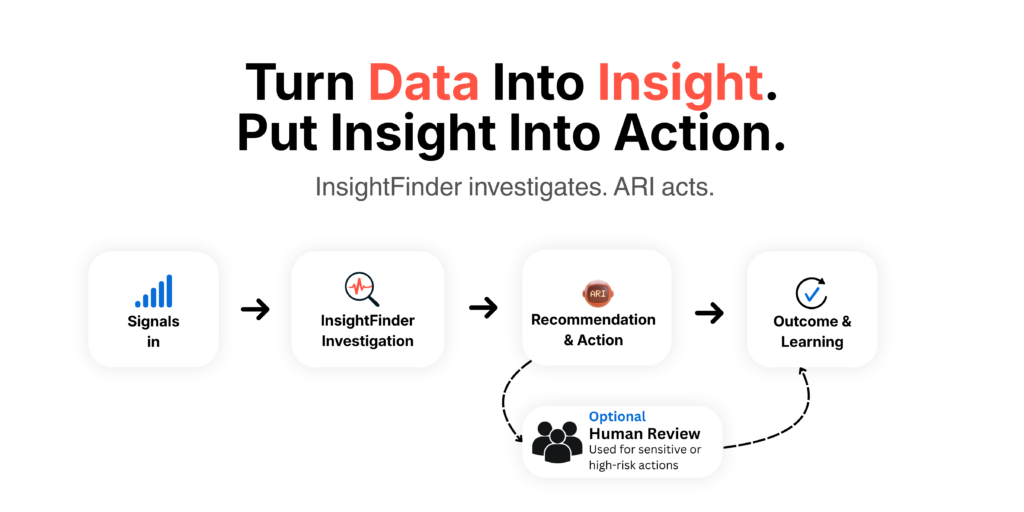
AI SRE addresses that gap by bringing AI into the reliability workflow. It helps teams identify meaningful deviations, connect the evidence, prioritize likely causes, and recommend or execute next steps under explicit controls.

Contents

Predictive AI SRE and AI-Driven IT Reliability Platform Features

1. A unified operational data foundation

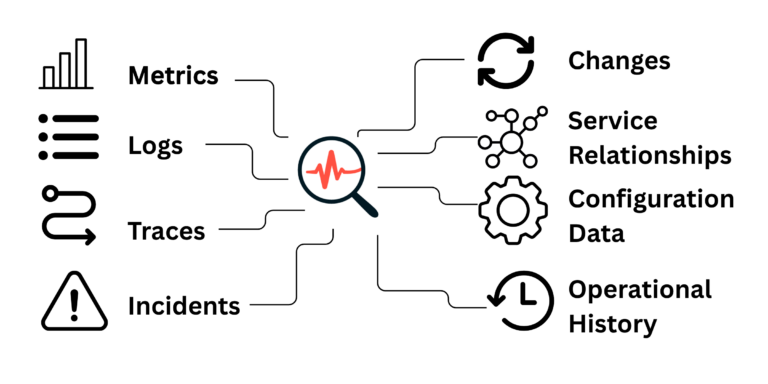
Reliable AI SRE decisions require complete operational context. AI SRE brings together the signals that reveal system health including metrics, logs, traces, incidents, changes, service dependencies, configuration data, and operational history.

InsightFinder’s IT Reliability Platform continuously detects anomalies across the full production stack, correlating signals from applications, infrastructure, networks, and services in real time. Instead of treating each monitoring stream in isolation, it provides AI SRE with holistic, cross-domain evidence to identify emerging issues, understand their impact, and accelerate root-cause analysis.


2. AI-driven anomaly detection

Static thresholds remain useful, but they are often brittle in dynamic environments. A threshold may miss a subtle but consequential change, or it may repeatedly alert on behavior that is normal in context.

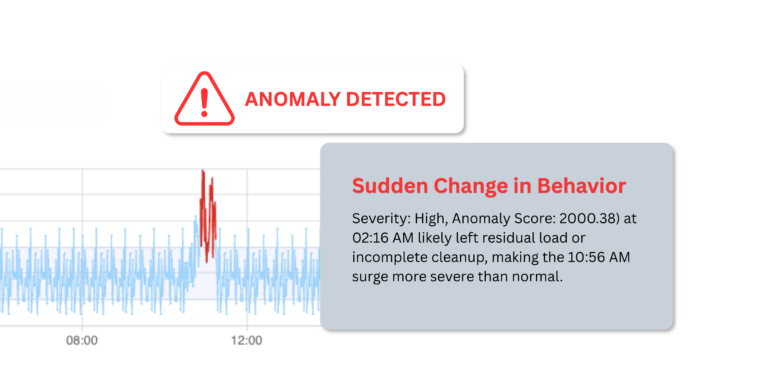
AI SRE uses machine learning to understand normal behavior and detect deviations that deserve attention. InsightFinder uses threshold-less, multivariate anomaly detection to identify unusual patterns across operational data without requiring teams to manually tune every possible condition.

The objective is not more alerts. It is fewer, higher-value signals that responders can investigate with confidence.

Real-Time Streaming Anomaly Detection

InsightFinder AI Anomaly detected

3. Causal root cause analysis

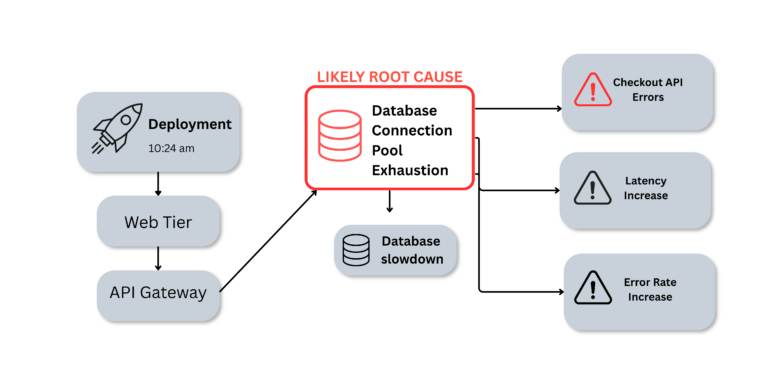
Correlation is not the same as causation. An application error can be related to a database slowdown, a configuration change, a network issue, or a failing upstream dependency. The first service that alerts is not necessarily the service that caused the incident.

AI SRE connects system behavior with change context and dependency relationships to help teams distinguish likely causes from downstream symptoms. InsightFinder correlates logs, metrics, and traces while providing service context for automated root cause analysis.

This reduces the time engineers spend manually rebuilding an incident narrative across disconnected tools.

Patented Root Cause Analysis (RCA)

RCA by InsightFinder AI

4. Prediction and risk prioritization

The best incident is the one customers never experience.

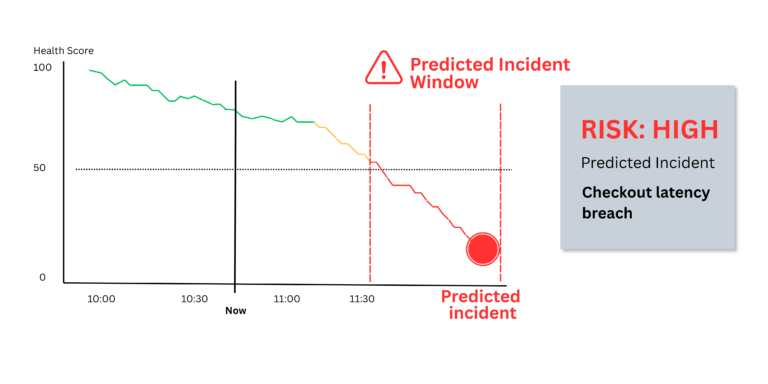
AI SRE extends beyond reactive response by identifying patterns that may indicate future risk, giving teams an opportunity to intervene before degradation becomes an outage. That can include unusual latency, rising error patterns, resource contention, a weakened dependency, or a recurring precursor to a known incident type.

Prediction is not a claim of certainty. It gives operations teams an earlier, evidence-based decision window.

predict outages

5. Governed action and continuous learning

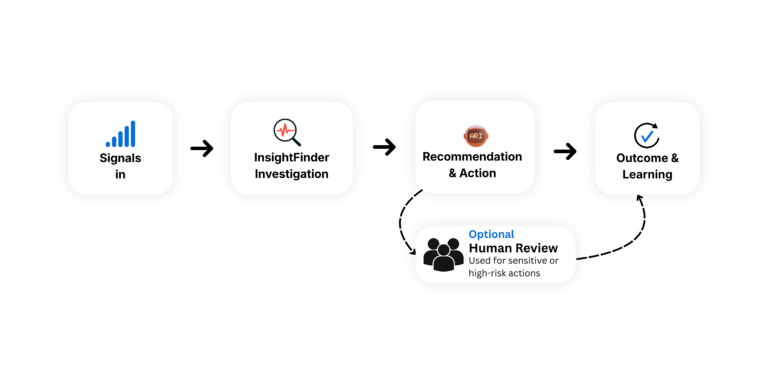
The goal of AI SRE is not blind autonomy. Production actions should be explainable, permissioned, auditable, and aligned to the organization’s risk tolerance.

A mature AI SRE workflow can begin with lower-risk tasks such as incident summaries, diagnostic collection, ticket creation, and runbook retrieval. Over time, teams can add policy-bound actions such as verification workflows, controlled restarts, or approved rollbacks.

Every validated incident also creates feedback: what happened, which evidence mattered, which action worked, and what should be recognized earlier next time.

Easily predict and remediate issues with AI SRE

Where ARI fits in Predictive AI SRE

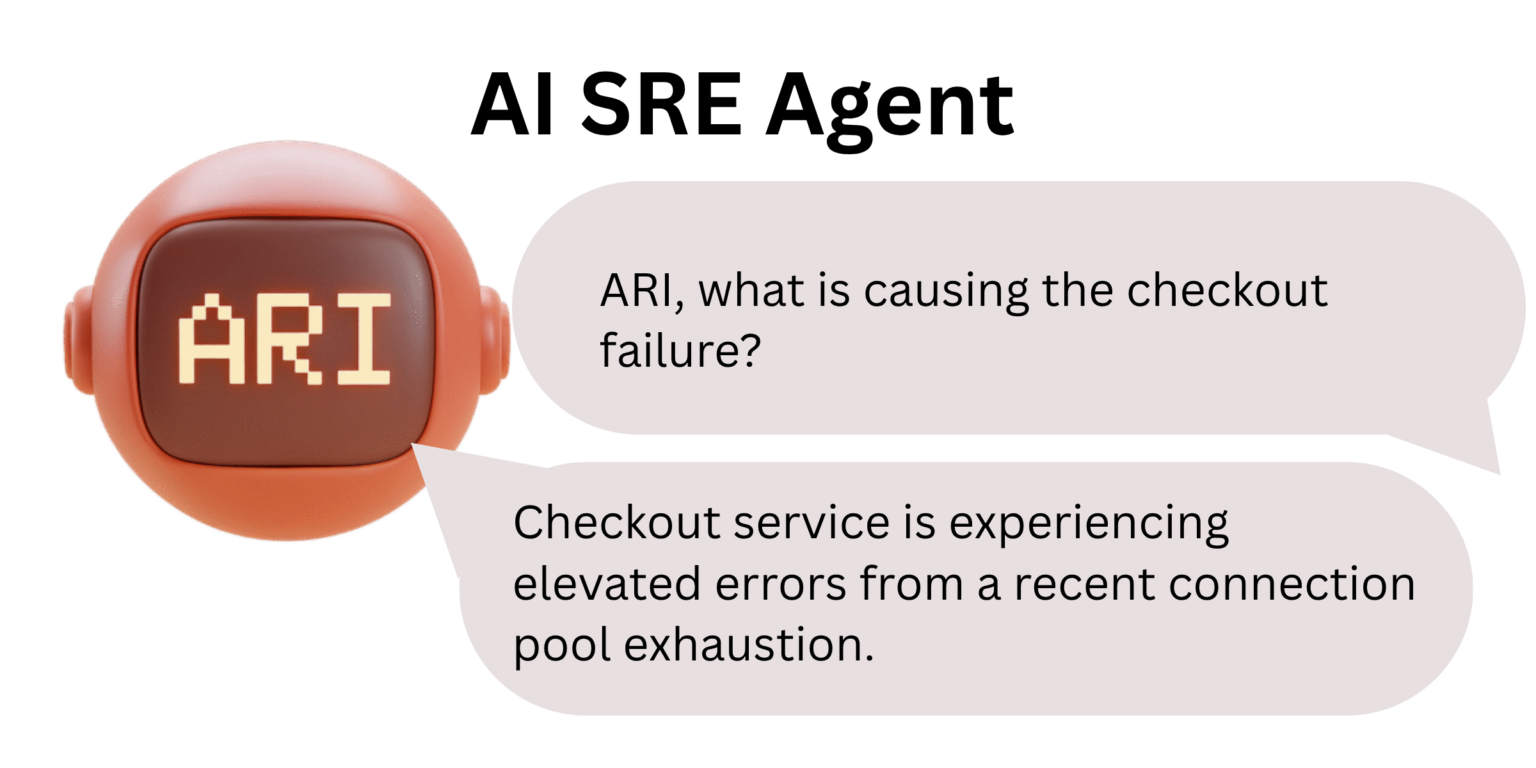
ARI is the Only Predictive AI SRE agent for preventing and resolving production incidents. It brings the platform’s predictive reliability intelligence directly into the day-to-day workflows of SRE and IT Operations teams.

ARI operates on real production evidence including anomalies, incident predictions, change events, causal relationships, service dependencies, and telemetry. Rather than waiting for something to break or offering generic recommendations, ARI helps teams understand what is happening, what is likely to happen next, why it is happening, and what action to take before users are impacted.

With ARI, teams can:

  • Start with a prioritized operational summary of unhealthy systems, emerging risks, predicted incidents, anomalies, and important changes.
  • Investigate predicted and active incidents through natural-language questions while maintaining full operational context.
  • Identify likely root causes and causal chains using evidence across metrics, logs, traces, changes, and system dependencies.
  • Review supporting tables, charts, and timelines to validate predictions and recommended actions.
  • Create JIRA tickets and initiate verification workflows, such as revert a buggy deployment or initiate a traffic re-routing.
  • Recommend or initiate policy-approved preventive and corrective actions, including deployment rollback and other remediation workflows.
  • Work directly from collaboration environments such as Slack and Microsoft Teams.

ARI is the agent layer of Predictive AI SRE. InsightFinder’s full-stack anomaly detection, incident prediction, causal root cause analysis, and dependency intelligence form the evidence and intelligence layer underneath it. Together, they move SRE from reacting to incidents after they occur to predicting, preventing, and resolving problems before business impact.

Learn more about ARI, InsightFinder’s Predictive AI SRE agent.

Contents

Predictive AI SRE vs. AI SRE, Observability, AIOps, and SRE

Approach Primary purpose Typical output
Monitoring Reports known conditions and system health signals Alerts, dashboards, threshold breaches
Observability Helps teams explore and understand system behavior Logs, metrics, traces, correlations, service context
AIOps Applies AI and analytics to operational data Noise reduction, anomaly detection, event correlation
Traditional SRE Applies engineering practices to build and operate reliable services SLOs, automation, incident response, reduced toil
AI SRE Applies operational AI and AI agents across detection, diagnosis, action, and learning Faster, evidence-backed, governed reliability operations
Predictive AI SRE Extends AI SRE to predict emerging failures, identify likely root causes, and enable preventive action before impact Early warnings, incident predictions, causal insights, and preventive actions

AI SRE does not replace monitoring, observability, AIOps, or human SRE practice. It connects them into a more intelligent and effective operational workflow.

Predictive AI SRE takes this one step further—from responding intelligently to problems to anticipating and preventing them. It continuously analyzes production signals to identify emerging risks, predict incidents before impact, explain likely causes, and recommend or execute governed preventive actions.

Contents

FAQs

The term can be used both ways, but in the reliability software market, AI SRE most often refers to a solution category or AI agent that performs parts of the operational reliability workflow. Human SREs remain accountable for reliability strategy, system design, governance, and consequential production decisions.

No. AIOps typically focuses on applying AI and analytics to operational data for functions such as anomaly detection, event correlation, and noise reduction. AI SRE extends the concept across the incident lifecycle by supporting investigation, causal analysis, governed action, and continuous learning.

No. AI SRE reduces repetitive, data-intensive operational work so engineers can spend more time validating diagnoses, making risk decisions, improving systems, and preventing repeat incidents. It should work with human oversight and well-defined access controls.

Yes, but mature AI SRE programs use governance. Teams commonly start with investigation, summarization, evidence retrieval, ticket creation, and diagnostic workflows. They can then expand to policy-approved, auditable remediation actions when confidence and operational controls are in place.

ARI is InsightFinder’s operational AI SRE agent for incident response. It helps teams prioritize unhealthy systems, investigate incidents using production evidence, review causal context, coordinate work, and support approved operational actions.

A predictive AI SRE is an AI agent that forecasts reliability incidents before they affect users, explains their likely root cause, and guides you to a fix ahead of impact. ARI, InsightFinder's AI SRE agent, brings this predictive approach to the end-to-end AI and IT reliability platform, so you can detect, explain, predict, and resolve issues across both AI and IT systems.

Most AI SRE tools start working only after an alert fires, which leaves your team reacting to incidents already in progress. ARI analyzes patterns in your telemetry to identify early warning signals, giving you time to act before a degradation becomes an outage. You keep control of remediation through human-in-the-loop review, so ARI's recommendations support your team's judgment.

Contents

Move from visibility to prevention

The next stage of reliability is not more dashboards. It is an operational model that helps teams turn telemetry into a trustworthy decision and a safe next step.

Explore InsightFinder IT Reliability and ARI to see how AI SRE can help your organization move from observability to prevention.

Contents

See how InsightFinder helps your team deliver reliable services across every layer of the stack

Take InsightFinder AI for a no-obligation test drive. We’ll provide you with a detailed report on your outages to uncover what could have been prevented.