Trusted by companies of all sizes






ARI is the only Predictive AI SRE that prevents production incidents automatically. It predicts emerging failures before impact and accelerates root-cause analysis by staying grounded in real operational evidence including anomalies, incidents, change events, and causal chains. You verify ARI’s predictions and findings, then take action quickly to prevent incidents and keep production reliable.

Trusted by companies of all sizes
Contents
ARI is the only Predictive AI SRE, built to predict, prevent, and resolve production incidents. It works at real-time speed across the reliability workflows your team already uses, continuously analyzing operational signals to identify emerging risks before they impact users.
Instead of guessing, ARI grounds every prediction, root-cause finding, and recommended action in real operational evidence. It continuously correlates telemetry, anomalies, incidents, change events, and causal dependencies across your production environment to predict failures and explain why they are likely to occur.
That grounding is the difference. ARI retrieves and correlates validated evidence from the tools you already use, then provides predictions, explanations, and recommended actions your engineers can verify. Your team stays in control while ARI does the heavy lifting: predicting risk, investigating root cause, and identifying the right action before problems become incidents.
InsightFinder works with enterprise reliability teams at companies including Dell, Visa, UBS, Lenovo, FedEx, and NBCUniversal.

ARI opens every shift with a summary of the last 24 hours. It prioritizes unhealthy systems and tells you what happened and what still needs your attention. You start with context instead of an empty search bar.
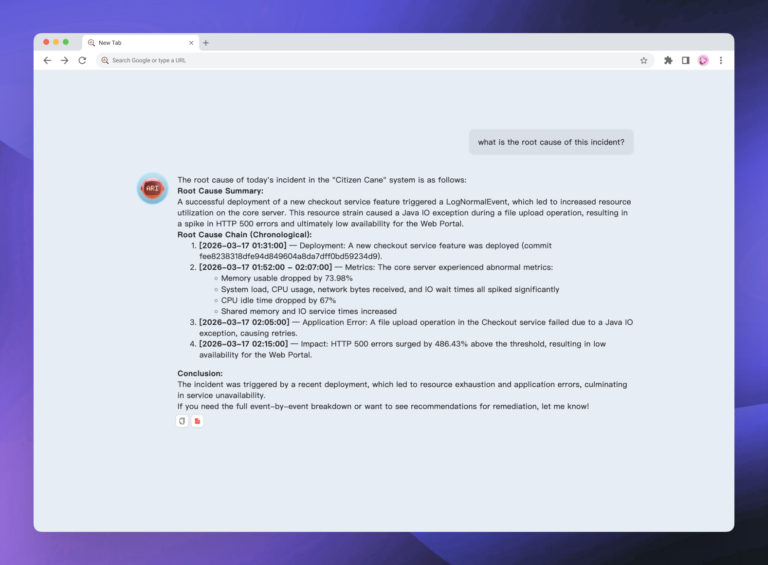
During an active incident, ARI returns root cause analysis at real-time speed. You can ask as many follow-up questions as you need. ARI retrieves incident context and narrows the scope as you probe, keeping continuity until you are ready to act.
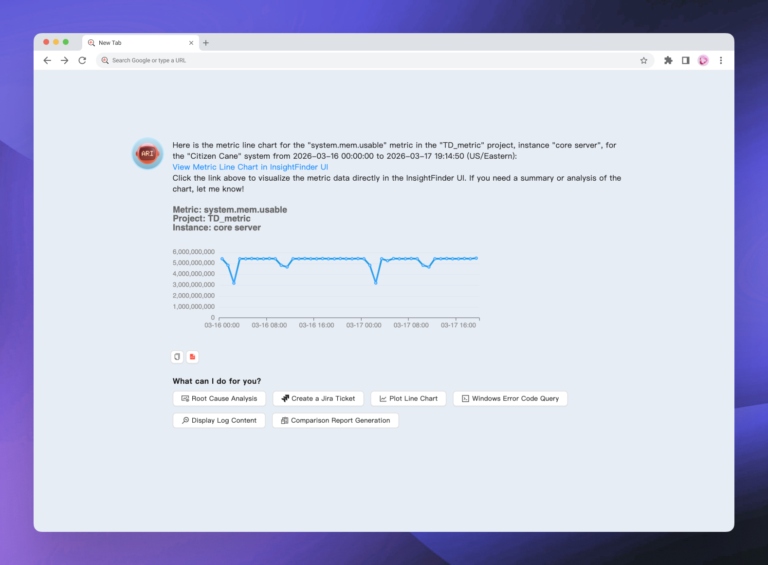
ARI shows its work. Every answer arrives with tables and charts alongside the explanation, so you can trace a conclusion back to the underlying telemetry and change events. That structure lets you verify a finding before you act on it.
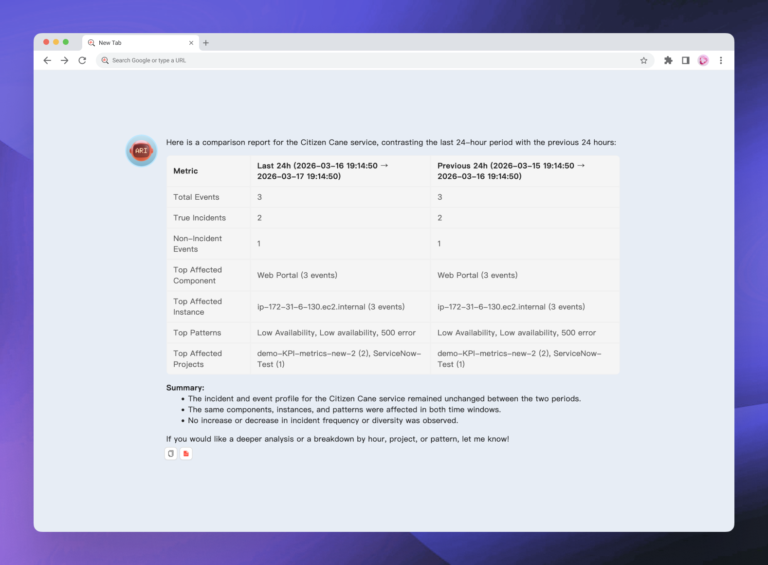
ARI produces comparison reports that place system health side by side across time windows. It surfaces the causal factors behind each shift, so you can quantify how reliability changed after a fix or a release.
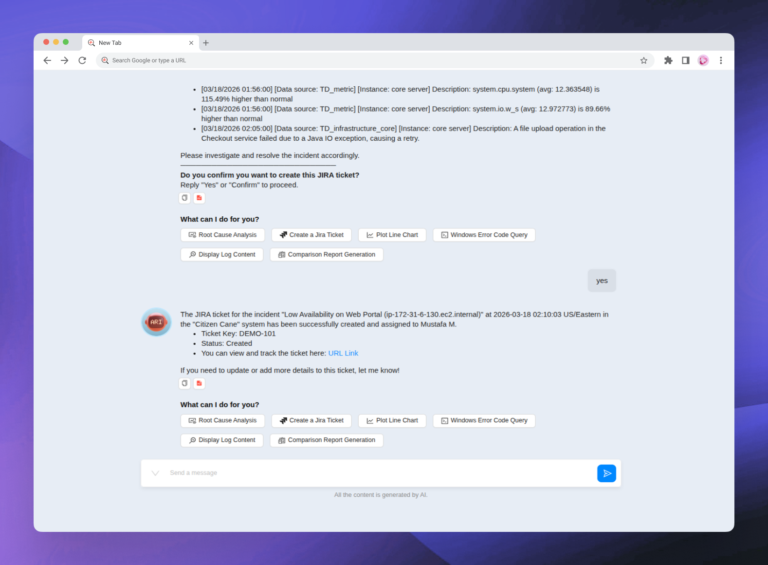
ARI acts on your behalf when you approve it. It creates JIRA tickets and triggers workflows like network probes to validate a root cause.
It can also remediate incidents with human-in-the-loop steps such as rolling back a buggy deployment. You keep the final say on every action.
You can work with ARI directly inside Slack or Microsoft Teams. Ask a question or start a validation workflow without leaving the channel where your team already coordinates.
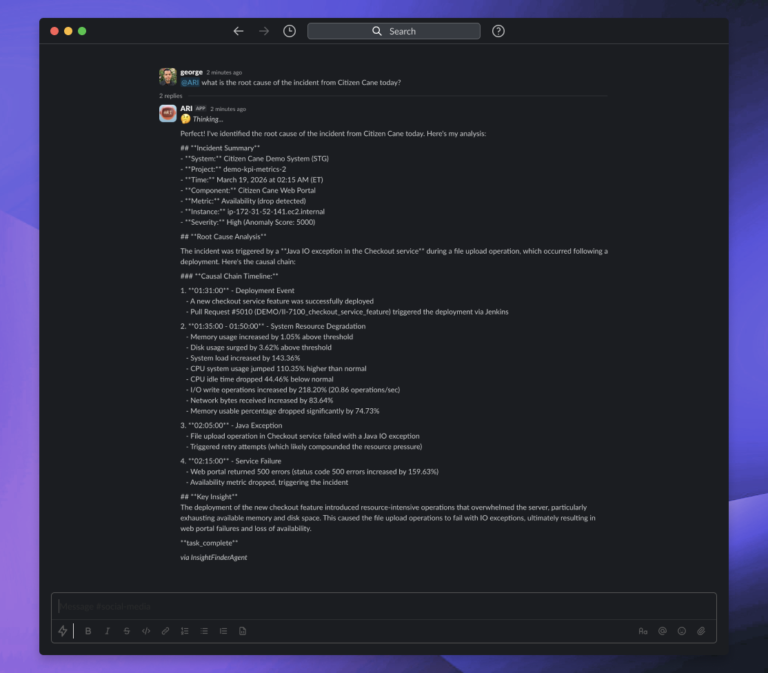
ARI keeps improving in production. Feedback loops built on InsightFinder’s online learning engine capture real signals from your environment. They refine the models against your systems, so accuracy climbs the longer ARI runs.
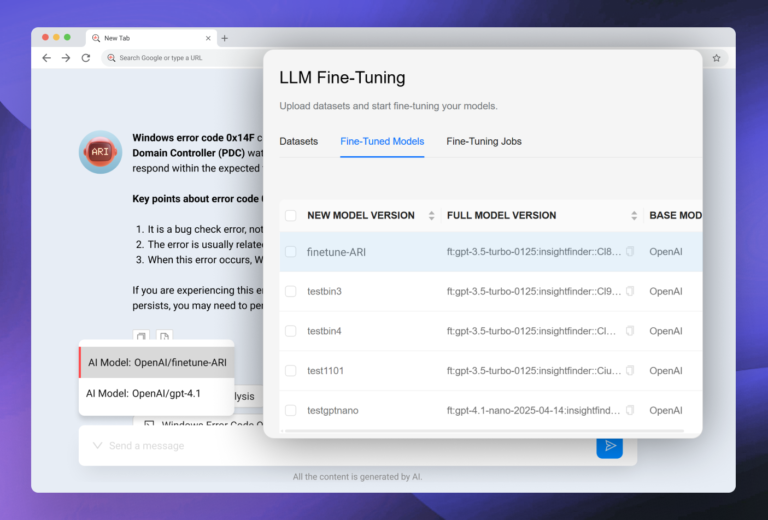
A general-purpose AI assistant answers questions. ARI predicts, prevents, and resolves production incidents. It is a Predictive AI SRE purpose-built for real-time reliability, helping teams identify emerging risks before they impact users and take action faster when problems occur.
ARI grounds every prediction, root-cause finding, and recommended action in your own operational telemetry, so its conclusions stay explainable and verifiable. It continuously correlates anomalies, incidents, change events, and causal dependencies to understand what is happening, predict what is likely to happen next, and determine the right action.
When action is needed, ARI can recommend or execute remediation with human approval—closing the gap between prediction, diagnosis, and resolution while keeping your engineers in control.
Pair ARI with InsightFinder’s IT reliability platform and AI reliability platform for predictive reliability across your entire production environment—from infrastructure and applications to AI models and agents.
ARI plugs into the reliability workflows your engineers already follow—but starts working before an incident happens. It continuously analyzes production signals to predict emerging risks, explain what is likely to fail, and help teams prevent impact.
| Workflow stage | How ARI helps |
|---|---|
| Predict and prevent | Detects emerging risks and predicts potential incidents before user impact |
| Investigate and diagnose | Correlates telemetry, changes, and dependencies to identify likely root causes |
| Verify | Provides structured, evidence-backed findings engineers can validate against production telemetry |
| Recommend and act | Recommends corrective actions or executes approved remediation with human oversight |
| Learn and improve | Learns from incidents, actions, and engineer feedback to continuously improve predictions |
| Measure reliability | Quantifies how reliability changes after fixes, releases, and operational improvements |
You do not replace your reliability process. You give it a Predictive AI SRE that continuously works ahead of incidents.
Because ARI runs on top of the InsightFinder Unified Intelligence Engine, it correlates metrics, logs, traces, events, topology, and change data across your production environment. This breadth allows ARI to connect early warning signals with causal dependencies—helping it predict what is likely to fail, explain why, and recommend what to do before users are impacted.
ARI connects to the tools you already run, with no rip-and-replace. It brings anomaly detection, root cause analysis, incident prediction, and automated remediation to your observability stack. See the full InsightFinder integrations catalog for details.
For monitoring and observability, ARI integrates with platforms including OpenTelemetry, Prometheus, Datadog, Elastic, and ServiceNow. It also works with leading model providers, including OpenAI, Anthropic, and Gemini.
During an incident, ARI provides root cause analysis quickly and lets you ask as many follow-up questions as you need to investigate further. It retrieves incident context and narrows the scope as you probe further, keeping continuity until you are ready to act.
ARI retrieves validated, precise evidence from the systems you already monitor, and it works at real-time speed. Every conclusion traces back to your actual telemetry. This grounding in your existing monitoring data is what lets you verify ARI's findings before you act on them.
No. ARI is a predictive AI SRE built to fit into the incident response workflows you already run, plugging into your existing observability and monitoring environment.
It brings AI-powered anomaly detection, root cause analysis, incident prediction, and automated remediation to those tools. You do not have to adopt a separate system.
ARI is a predictive operational agent designed to be useful at real-time speed. It retrieves precise, validated evidence from the systems you already monitor, and it helps you drill down with continuity until you are ready to act.
ARI can also act on your behalf, going beyond answering questions to help you resolve incidents.
Take InsightFinder AI for a no-obligation test drive. We’ll provide you with a detailed report on your outages to uncover what could have been prevented.


